support@biotechpeptides.ca
-
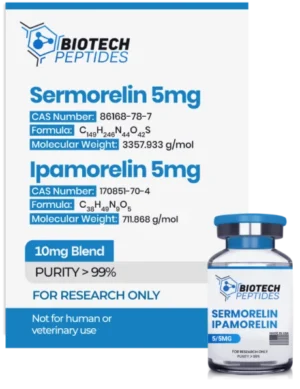
Sermorelin & Ipamorelin Blend (10mg)
Molecular Formula: C149H246N44O42S
Molecular Weight: 3357.9 g/mol
Sequence: Tyr-Ala-Asp-Ala-lle-Phe-DL-Thr-Asn-Ser-Tyr-Arg-Lys-Val-Leu-Gly-Gln-Leu-Ser-Ala-Arg-Lys-Leu-Leu-Gln-Asp-Ile-Met-Ser-Arg-NH2
$81.00 -
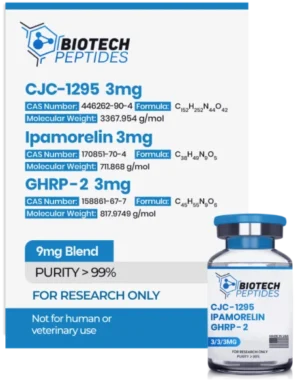
CJC-1295 (Mod GRF 1-29) & Ipamorelin & GHRP-2 Blend (9mg)
CJC-1295 is classified as a Growth Hormone Secretagogue (GHS), also known as DAC:GRF. It is an advanced version of GHRH (1-29), synthetically developed with the intention of producing better pharmacokinetics, potentially increasing Growth Hormone levels and Insulin-Like Growth Factor 1 (IGF-1). According to research, it exhibits the potential to increase the production level of Growth Hormone anywhere from 200-1000%. Moreover, the research developers commented that CJC-1295 may increase “mean plasma IGF-I concentrations by 1.5- to 3-fold.”[1] This apparent rise in growth hormone level has been reported to persist for about 6-8 days under study conditions. A longer half-life would ensure the increased level of growth hormone production even beyond the initial introduction of the peptide.
$80.00 -
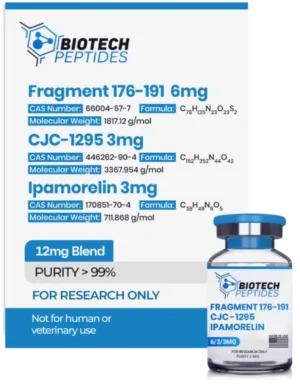
Fragment 176-191 & CJC-1295 & Ipamorelin Blend (12mg)
Fragment 176-191 houses the primary proposed ‘lipolytic fragment’ of the growth hormone (hGH) and it potentially targets the beta-3 adrenergic receptors (ADRB3), which may facilitate its suggested weight-loss potential. This peptide is proposed to amplify fat burning in adipose tissue cells and stimulate ‘thermogenesis’ in skeletal muscle cells via these receptors.[1]
CJC-1295 (Mod GRF 1-29), is an apparently enhanced version of GHRH (1-29) crafted to potentially optimize its pharmacokinetics. It is posited to elevate growth hormone and Insulin-Like Growth Factor 1 (IGF-1) levels. Research suggests it may increase growth hormone production between 200-1000%. Furthermore, CJC-1295 is believed to increase plasma IGF-I concentrations by 1.5- to 3-fold.[2]
Ipamorelin, a five-amino-acid chain, is identified as a Growth Hormone Secretagogue (GHS). It is posited to function similarly to Growth Hormone Releasing Peptides (GHRPs) and to apparently emulate the natural hunger hormone, ghrelin, particularly its potential to stimulate the release of hGH from pituitary cells.[3] A notable feature of Ipamorelin research is its apparent selectivity and its reported negligible influence on the secretion of other pituitary hormones like cortisol, prolactin, and aldosterone.
$87.00 -
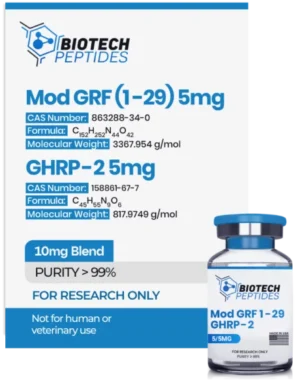
Mod GRF 1-29 & GHRP-2 Blend (10mg)
Modified GRF 1-29 (also abbreviated as Mod GRF 1-29), is a synthetic peptide analog of Growth Hormone Releasing Hormone (GHRH). It is a modified version of the first twenty-nine amino acids of the naturally occurring GHRH. This modification has been suggested to provide better stability and potentially reduce metabolic clearance. More specifically, the modifications may involve the substitution of four specific amino acids within the initial 29 amino acids of Growth Hormone-Releasing Hormone (GHRH). These changes occur at the 2nd, 8th, 15th, and 27th positions and may potentially enhance the peptide’s durability against enzymatic degradation, especially by enzymes such as dipeptidyl peptidase-4 (DPP-4). It is hypothesized that replacing L-alanine with D-alanine at the second position may increase resistance to molecular breakdown. Furthermore, replacing asparagine with glutamine at the eighth position might reduce the likelihood of asparagine reconfiguration and amide hydrolysis. Additionally, substituting glycine with alanine at the 15th position may improve bioactivity. Lastly, the switch from methionine to leucine at the 27th position is thought to help prevent methionine oxidation. It may lead to natural growth hormone production and increased levels of IGF-1 (Insulin-Like Growth Factor-1).
$84.00 -
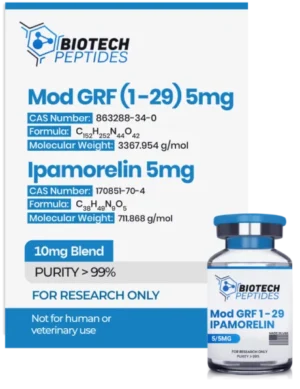
Mod GRF 1-29 & Ipamorelin Blend (10mg)
Modified GRF 1-29 and Ipamorelin are separate peptides, which research indicates may work synergistically to induce potential growth hormone release and growth hormone pulses. This increase may result in several downstream physiological activities associated with increased growth hormone release. Modified GRF 1-29 peptide is an analog of growth hormone-releasing hormone (GHRH).[1] It is also known as tetra-substituted GRF (1-29), and is composed of a sequence thought to be the smallest necessary to interact with GHRH receptors, specifically the first 29 amino acids of GHRH. On the other hand, Ipamorelin is suggested to act via binding to growth hormone secretagogue (GHS) receptors.[2] These receptors are also known as the ghrelin receptors, and Ipamorelin appears to be a highly selective pentapeptide that binds and activates them.
$81.00 -
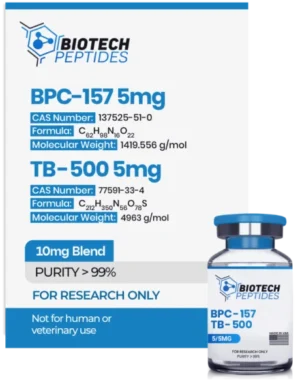
BPC-157 & TB-500 Blend (10mg)
BPC-157 and TB-500 peptides have both been examined in research on tissue repair processes, although study findings indicate that the compounds may use different biochemical pathways to achieve this potential. Researchers also hypothesize that the two molecules may exhibit synergistic effects in the healing process when exposed in combination.[1] The synergistic effect of the blend may improve the overall flexibility and adjustability of the tissues following damage.
$115.00 -
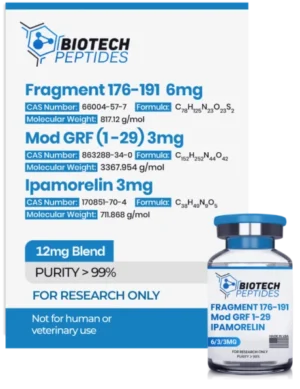
Fragment 176-191 & Mod GRF 1-29 & Ipamorelin Blend (12mg)
Studies have suggested that a maximal output of endogenous growth hormone (GH) from the anterior pituitary gland might be attained through a combination of growth hormone-releasing hormone (GHRH) analog and agonist of growth hormone secretagogue receptor (GHSR).[1] The combination of Ipamorelin with Modified GRF is one of the various combinations researchers have studied in an effort to achieve maximal growth hormone production. Interestingly, more specific results appear to be achieved beyond the increase in GH synthesis by refining the choice of GHRH and GHSR evaluated in a particular study. Modified GRF, which researchers have suggested may be a potent GHRH analog, may have impacts beyond growth hormone release. It has been speculated to impact intestinal inflammation, tissue repair, and cardiac function in addition to researchers’ suppositions on its impact on growth hormone release. Ipamorelin, classified as a growth hormone secretagogue, appears to interact with the GHSRs, also known as ghrelin receptors, and may have the potential to impact bone growth. Activating the ghrelin receptors may affect appetite, to increase food consumption and total weight gain. Depending on the desired outcome of the particular study, namely the addition or reduction of weight, this specific receptor activity may be mitigated by adding lipolytic molecules, which may help minimize the possibility of fat increase. Fragment 176-191 is often combined with Ipamorelin and other research peptides. The peptide known as Fragment 176-191, also referred to as hGH Fragment 176-191, Frag 176-191, tyr-hGH 177-191, or AOD-9604, is hypothesized to specifically target the fat-reduction pathways of growth hormone. This peptide consists of a sequence of 16 amino acids derived from the terminal portion of the growth hormone molecule, identified by researchers as the “lipolytic fragment” due to its potential fat-burning capabilities. The term ‘lipolytic’ describes the fragment’s capacity to promote fat breakdown. To enhance the peptide’s stability, the initial amino acid in the hGH Fragment 176-191 sequence is substituted with tyrosine, leading to its alternate designation as Fragment tyr-hGH 177-191.
$87.00 -
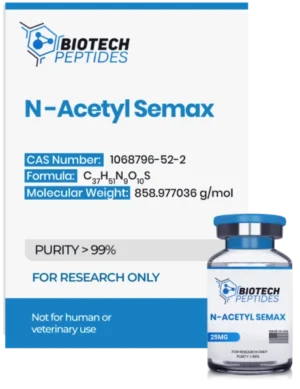
N-Acetyl Semax (25mg)
N-Acetyl Semax is posited to be an acetylated form of the Semax peptide. The peptide consists of a 4 amino acid fragment (Met-Glu-His-Phe) from the chain of melanocortin hormones. These include the adrenocorticotropic hormone (ACTH) and a Pro-Gly-Pro fragment. The integration of Pro-Gly-Pro (PGP) into N-Acetyl Semax may potentially enhance the permeability of the peptide through the blood-brain barrier (BBB). This enhancement might occur by increasing the peptide’s lipophilicity, thereby potentially improving passive diffusion or uptake via lipid raft-mediated endocytosis.
This process may hypothetically allow the peptide to bypass the BBB’s tight junctions, which researchers claim are usually highly restrictive. Adding PGP at the C-terminus might also modify the peptide’s interactions with specific BBB transporters or receptors, possibly facilitating receptor-mediated transcytosis. Receptor-mediated transcytosis is a process where substances are transported across cells via specific receptors, and alterations at the C-terminus might influence this pathway.
Researchers have noted that the acetylation of the peptide into N-Acetyl Semax appears to reduce the affinity of other ions, such as Cu++, to its N-terminus.[1] Acetylation may contribute to an increase in the peptide’s resistance to enzymatic degradation, potentially leading to an extended half-life observed in experimental models. Increased resistance to degradation might mean that the peptide potentially remains active for a longer period, which may enhance its stability.
$57.00 -
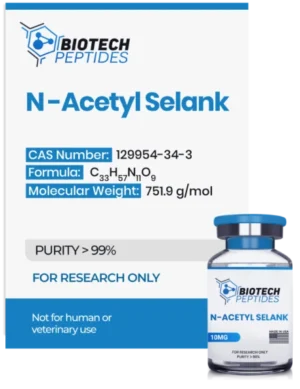
N-Acetyl Selank (10mg)
N-Acetyl Selank is an acetylated form of the Selank peptide. The acetylation of the peptide into N-Acetyl Selank appears to improve its stability. Selank is a synthetic analogue of the natural tetrapeptide Tuftsin. Tuftsin is an immunomodulatory peptide, and N-Acetyl Selank appears to share many of its potential functions. In addition, N-acetyl Selank also appears to exhibit an impact on neurotransmitters, brain signaling, and neuroplasticity.
$65.00 -

Retatrutide (6mg)
AMP-3P 6mg is a ≥ 99 % pure triple-agonist peptide supplied as a lyophilized
powder.$55.00 -
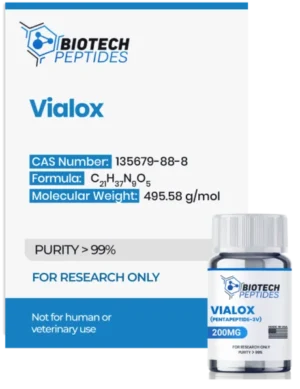
Vialox (Pentapeptide-3V) (200mg)
Vialox, also known as Pentapeptide-3V, is a peptide with a five amino acid sequence (Gly-Pro-Arg-Pro-Ala). It was originally isolated from endogenously produced snake venom. The peptide appears to replicate temporary muscular paralysis. This result has been observed by researchers in paralytic compounds such as botulinum toxin, which are believed to reduce wrinkle depth. Vialox appears to inhibit nicotinic acetylcholine receptors. This potential may enable curare-like actions at the neuromuscular junction, which might block nervous system electrical impulses from reaching muscles. A block like this may ultimately halt muscle contraction.
This mechanism appears to be analogous to the function of tubocurarine. This function is observed through Vialox’s hypothetical interaction with acetylcholine receptors on the postsynaptic membrane of muscle cells. Tubocurarine, a naturally occurring alkaloid compound, is primarily found in the bark of certain plants. This includes Chondrodendron tomentosum, commonly referred to as “curare.” Experts recognize this compound as a potent neurotoxin. Its mode of action is considered to function as a non-depolarizing neuromuscular blocker. It is hypothesized that this function obstructs the activity of acetylcholine—a neurotransmitter deemed by researchers to be critical for muscle contraction—at the neuromuscular junction, which might inhibit muscle contraction.
$210.00 -
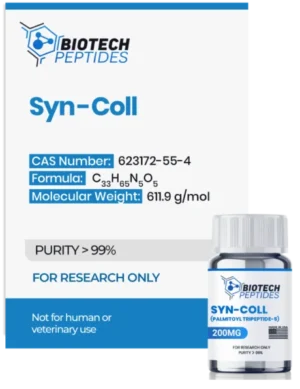
Syn-Coll (Palmitoyl Tripeptide-5) (200mg)
Syn-Coll, otherwise known as Palmitoyl Tripeptide-5 or Tripeptide-5, is a synthetic peptide that was developed to enhance the production of type I collagen. It appears to repair damages caused by photo-aging, and Syn-Coll has also been suggested to support the regeneration of skin protein production, such as elastin or collagen. Syn-Coll (Palmitoyl Tripeptide-5) is the synthetic equivalent of Thrombospondin 1 (TSP-1). TSP-1 is an extracellular matrix protein and is found in the skin near collagen and elastin. Syn-Coll appears to mimic the functions of TSP-1, possibly aiding in the prevention of collagen degeneration via stimulating the release of TGF- induced by TSP-1.[1] TGF-β is an essential growth factor potentially significant in preserving skin integrity and facilitating the development of skin structures, mainly through the promotion of collagen synthesis. Additionally, Syn-Coll, a synthetic peptide, has been the subject of extensive research in animal models and laboratory experiments. The findings tentatively indicate that Syn-Coll might enhance collagen production and potentially inhibit its degradation. The inhibition of collagen breakdown by Syn-Coll is possibly due to its ability to suppress the activity of matrix metalloproteinases (MMPs), including MMP1 and MMP3, which are enzymes studied for their role in the degradation of collagen in the skin. The peptide is palmitoylated, to potentially extend its bioavailability in experiments involving different skin tissue models.
$217.00 -
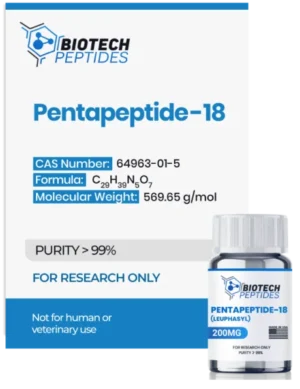
Pentapeptide-18 (Leuphasyl) (200mg)
Pentapeptide-18 (Leuphasyl) is a modified analog of the naturally occurring pentapeptide leu-enkephalin, which is part of a class of peptides called enkephalins which are believed to directly interact with opioid receptors.[1] Structurally, Pentapeptide-18 differs from leu-enkephalin by the addition of D-Alanine in place of glycine at its second position. Pentapeptide-18 is thought to penetrate the epidermal barrier and influence cellular processes that affect muscle cell contraction. Studies suggest that it acts by modulating calcium release in neuronal synapses. By interfering with the signals that trigger muscle contraction, Pentapeptide-18 may help to relax muscles, reducing the formation of fine lines and wrinkles across the skin barrier. Additionally, modified versions of Pentapeptide-18 may interact with melanin production pathways, which is a pigment responsible for adding color to tissues and may play a protective role against UV radiation. By potentially influencing melanin synthesis, modified versions of Pentapeptide-18 may offer research value in skin tissue studies.
$215.00 -
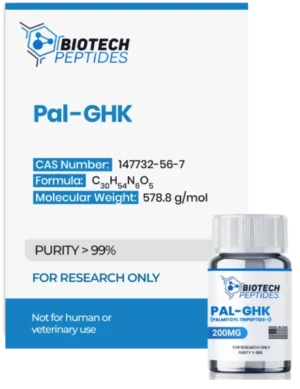
Pal-GHK (Palmitoyl Tripeptide-1) (200mg)
Pal-GHK, also known as Palmitoyl Tripeptide-1 and Palmitoyl Oligopeptide, is a synthetic peptide developed to function in protein production to support the skin’s extracellular matrix (ECM), and skin pigmentation. Pal-GHK is a synthetic hybrid peptide with one fatty acid and one peptide. “Pal” represents Palmitoyl—the covalent attachment of fatty acid to the end of the structure. “GHK” represents glycine-histidine-lysine—the peptide’s amino acid structure. This sequence is thought to be a small fraction of the large protein collagen, which is one of the main proteins in the extracellular matrix of skin and other tissues. The GHK sequence appears to be present in the “alpha 2(I) chain of type I collagen”, and researchers suggest that such a “tripeptide might be liberated by proteases at the site of a wound” as a signal of injury and thus, may be a powerful stimulant for repair.[1] Particularly, it may signal and attract fibroblasts—cells responsible for synthesizing collagen, elastin, and other proteins in the skin’s extracellular matrix, bones, and connective tissues. “Pal” represents Palmitoyl—the covalent attachment of fatty acid to the end of the structure. The addition of palmitoyl to the molecule is thought to result in better penetration through skin cells and, more specifically, stratum corneum.
$119.00 -
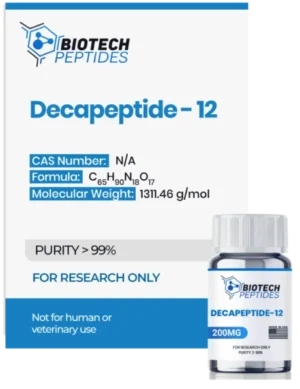
Decapeptide-12 (200mg)
Decapeptide-12 is an oligopeptide with proposed anti-tyrosinase activity, composed of twelve amino acids and exhibiting the sequence Try-Arg-Ser-Aar-Lysd-Tyr-Ser-Ser-Trp-Tyr. It is thought to function primarily to restrain Tyrosinase—the enzyme researchers believe is responsible for the excessive production of melanin, which may result in patchy pigmentation upon the epidermal layer’s surface.
$226.00