support@biotechpeptides.ca
-
Lipopeptide (Biopeptide EL) (200mg)
Lipopeptide is a common name for Biopeptide EL, also known as palmitoyl hexapeptide-12. As the name suggests, this peptide is made of six amino acids and has a palmitic fatty acid addition. The inclusion of palmitic acid within the Lipopeptide structure is thought to enhance penetration to the deeper layers of various structures made of skin cells. The amino acids in the peptide are valine-glycine-valine-alanine-proline-glycine (VGVAPG), and the sequence is one of the most common found in naturally occurring proteins like elastin and its precursor, tropoelastin.
By mimicking fragments of elastin, the peptide is thought to interact with fibroblast cells and exert a potential impact on the production of vital proteins to the skin’s extracellular matrix (ECM). Fibroblasts are a subset of cells found in connective tissue, such as the one that provides support for skin cells. Fibroblasts can actively produce ECM proteins, and some of the most important proteins are considered to be collagen, elastin, and hyaluronic acid. According to scientific research, Lipopeptide may potentially enhance the creation and growth of collagen and hyaluronic acid within the ECM.
$220.00 -
Nonapeptide-1 (200mg)
Nonapeptide-1, also termed Melanostatine-5, is a peptide that may prevent the activation of pigment-producing cells in the skin called melanocytes. It appears to be one of the most potent inhibitors of a receptor found in these pigment-producing cells, called the melanocortin-1 receptor (MC1R). Researchers have explored a peptide library containing 31,360 structurally different compounds, and it appears that the most potent inhibitor identified was Met-Pro-D-Phe-Arg-D-Trp-Phe-Lys-Pro-Val-NH₂, aka Nonapeptide-1.[1] Structural analysis has revealed that specific amino acids, such as D-Trp at position 5 and Phe at position 6, are considered crucial for their antagonistic potential. The presence of D-Phe at position 3 further underscores such potential. Research on animal models suggests that Nonapeptide-1 may inhibit the synthesis of melanin, bringing it to the forefront of research on conditions impacting skin pigmentation, such as melasma. Studies in animal models posit that Nonapeptide-1 may reduce the synthesis of melanin and potentially decrease pigmentation on a considerable scale.
$210.00 -
Pal-AHK (200mg)
Pal-AHK, also referred to as Palmitoyl Tripeptide-3, is a tripeptide with a fatty acid attachment. It consists of amino acid sequences (alanine-histidine-lysine) and appears to be attached to a Palmitoyl fatty acid molecule. The fatty-acid component of AHK makes it lipophilic (soluble in fat), which may increase the potential of the peptide for penetration and absorption by epidermal cells in experimental models while maintaining the same mechanisms of action as regular AHK. AHK appears to be a multifunctional copper-binding peptide that has been studied for its potential role in supporting cellular functions related to the kin’s extracellular matrix.
Research indicates that AHK-Cu may increase the proliferation and viability of dermal fibroblasts—the primary cells responsible for producing collagen and other essential proteins in the extracellular matrix (ECM).[1] Moreover, the peptide appears to possess significant antioxidative potential compared to other tripeptides when investigated via chromatographic evaluations. This appears to be related to its potent metal-chelating properties.
$180.00 -
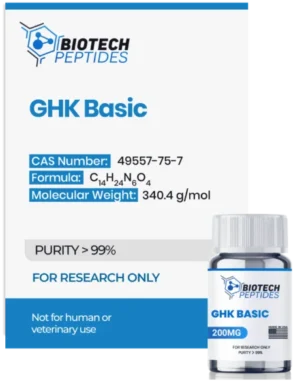
GHK Basic (Tripeptide-1) (200mg)
GHK is an endogenous copper peptide that occurs in the tripeptide glycyl-L-histidyl-L-lysine. It has two variants — GHK with or without Cu (Copper). GHK appears to have a strong affinity for copper (II), and it is synthesized from plasma, although it has been isolated in other areas. Endogenous GHK production is considered to decline over time. [1]
In cases of injury, GHK may be released from tissue cells. That may be because GHK is present in various proteins that get broken down via hydrolysis during injury. For example, studies suggest that GHK is present in the “alpha 2(I) chain of type I collagen”, which “suggests that the tripeptide might be liberated by proteases at the site of a wound and exert in situ healing.” [2] GHK peptide may also be released from the breakdown of another extracellular matrix-binding protein involved in regulating cell shape and proliferation, called SPARC (Secreted Protein, Acidic, and Rich in Cysteine). GHK is found in tissues undergoing remodeling, such as during the process of angiogenesis.[3]
When GHK is released from the breakdown of proteins like collagen and SPARC, this signaling appears to trigger the fibroblasts to begin synthesizing new collagen and other structural proteins in the skin structure and connective tissues like elastin and glycosaminoglycan. Further, this copper-binding peptide appears to affect genes that control recuperative responses to injury and stress. Its functions appear to include the following: tissue remodeling, anti-inflammatory response, pain perception inhibition, nootropic, anti-cancer action, blood vessel growth, and nerve outgrowth.
$165.00 -
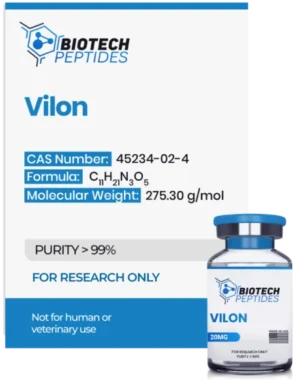
Vilon (20mg)
Vilon (or Lyslglutamic Acid) is a peptide with apparent immunomodulatory and anti-aging bioregulation potential. It is a short peptide with just two amino acids in length. Scientific research suggests it may potentially act to regulate the vascular system and encourage hemostasis. Its functions may be more widespread, with studies indicating its possible influence in reducing the prevalence and growth of spontaneous tumors. Advocate researchers like Dr. Vladimir Anisimov believe that the peptide may become more widespread in contemporary research within the context of geroprotection.
$61.00 -
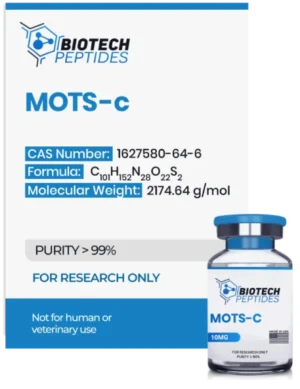
MOTS-c (10mg)
MOTS-c (mitochondrial open-reading-frame of the 12S rRNA-c) is a 16 amino acid peptide classified as a Mitochondrial-Derived Peptide (MDP), aka “mitochondrial hormone” or “mitokine.” Recent research indicates that MOTS-c is a bioactive peptide closely associated with mitochondrial communication and energy regulation. Initially, researchers hypothesized that it might be most active in the mitochondria, however recent studies suggest otherwise, that MOTS-c may operate via the bloodstream, exhibiting a potentially systemic action.
It is important to note that MOTS-c is a newly identified MDP. Its primary roles are under investigation, but studies include MOTS-c peptide’s influence in cell function and longevity, muscle contractile force, metabolic function and weight regulation.
$99.00 -
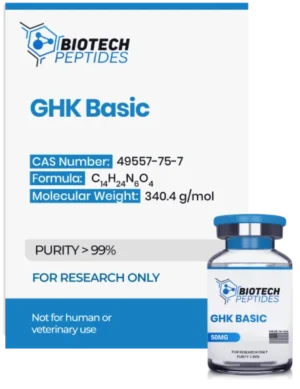
GHK Basic (50mg)
GHK is a copper peptide that occurs naturally in a copper complex of the tripeptide glycyl-L-histidyl-L-lysine. It has two variants — GHK with or without Cu. GHK appears to have a strong affinity for copper (II), and it is synthesized naturally from plasma, although it has been isolated in other areas. In cases of injury, GHK may be released from tissue cells. The copper peptide appears to affect genes that control injury and stress responses. Its functions appear to include the following: tissue remodeling, anti-inflammatory response, pain perception inhibition, nootropic action anti-cancer action, blood vessel growth, and nerve outgrowth. A decrease in the regenerative capacity of an organism may be traced to a decline in GHK-level. Its potential functions extend to infection control, follicle growth, collagen and elastin production increases, tissue repair, and glycosaminoglycan synthesis. Endogenous GHK production is considered to decline over time.
$51.00 -
-
Livagen (20mg)
Livagen is a short peptide bioregulator, similar in structure to Epitalon. It is a tetrapeptide made of the amino acids Lys-Glu-Asp-Ala (KEDA) and is classified amongst Khavinson’s peptides. As a bioregulator, the peptide may interact with genetic material in different cells and consequently unpack and “unlock” various cellular genes. Livagen’s impacts appear to be exhibited directly on the lymphocytes (cells of the immune system), liver, and gastrointestinal tract (GIT). Its direct functions may be widespread, as suggested through research studies on DNA and gene expression patterns. The potential of the Livagen peptide to activate genes enclosed in the GIT and immune system may reflect possible age-mitigating characteristics exerted on cells.
$62.00 -
Cardiogen (20mg)
Cardiogen is a cardiovascular bioregulator peptide complex. Results obtained from research studies suggest that Cardiogen’s primary functions may be correlated to fibroblast action, cells considered responsible for scar formation and tissue repair. The peptide has a sequence of H-Ala-Glu-Asp-Arg-OH (AEDR).[1] Research posits that the synthetic tetrapeptide Cardiogen may potentially stimulate cell proliferation in myocardial tissue. Additionally, it appears that Cardiogen may possibly inhibit myocardial cell apoptosis (cell death), hypothetically through the reduction of p53 protein expression.
$62.00 -
Syn-AKE (200mg)
Syn-AKE is a peptide, also known as tripeptide-3 or dipeptide diaminobutyroyl benzyl amide diacetate. Syn-AKE, a synthetic peptide ingredient, appears to mimic the actions of the Waglerin-1 peptide, which is 21 amino acids in length. Waglerin-1 functions primarily as a muscle relaxant by inhibiting the activity of acetylcholine at the neuromuscular junction, which may potentially result in reduced muscle contractions. Acetylcholine is a neurotransmitter considered essential for muscle movement, and its inhibition at the neuromuscular junction prevents the normal contraction signals from reaching muscles. In the development of Syn-AKE, researchers sought to synthesize a peptide that might potentially mimic this action. Thus, the peptide Syn-AKE was engineered to emulate the mechanism by which Waglerin-1 acts, but in a more selective manner. Researchers suggest Syn-AKE may act to reduce transmission between muscles and nerves, working similarly to botulinum toxin to relax muscles and thus reduce instances of creasing and wrinkle development along epidermal surfaces, as suggested in animal model research. The apparent reduction of this transmission appears to be reversible when triggered by Syn-AKE. Therefore its action is temporary.[1] According to Pentapharm, “the Syn-AKE invokes its action by blocking the muscle nAChR in a reversible manner by blocking the ion channel. As a result, the Na+ uptake is substantially disturbed, and the muscles remain relaxed.”
$210.00 -

PTD-DBM (5mg)
PTD-DBM stands for Protein Transduction Domain-fused Disheveled Binding Motif. It is a synthetic peptide which has been studied within a wide range of research areas, including tissue damage and hair follicle development. Researchers have focused on the peptide specifically within the context of follicle development, suggested it may exert stimulating action through interaction with the endogenous proteins linked to follicle damage called CXXC5.[1] It was discovered by Professor Kang-Yell Choi and his team of researchers at the Yonsei University in South Korea. The researchers studied the mechanism of hair follicle loss, and suggested that the cellular pathway Wnt/β-catenin may be crucial for follicle development.
The Wnt/β-catenin pathway is often studied in the context of tissue development and regeneration, Wnt proteins are a family of secreted signaling molecules that bind to cell surface receptors to trigger a cascade of intracellular events. β-catenin is a protein that normally resides in the cytoplasm of cells. Upon activation of the Wnt pathway, β-catenin is thought to accumulate in the cell and translocate to the nucleus, where it may activate the transcription of specific target genes involved in cell growth and differentiation. The activation of β-catenin may have a role in supporting and even increasing hair follicle development and possibly initiating the anagen phase, which represents the growth stage of hair follicles, as observed in murine models.
It has been hypothesized that PTD-DBM may interfere with the binding of CXXC5 and Dishevelled (Dvl) proteins by acting as a competitor. Specifically the peptide might inhibit the interaction between CXXC5 and Dishevelled (Dvl) proteins by binding to the PDZ domain of Dvl, thus interfering with CXXC5’s inhibitory actions on Wnt/β‐catenin signaling. Such a disruption might support the Wnt/β-catenin signaling pathway, thereby possibly promoting the onset of the anagen phase. Data from such murine studies suggests elevated expression levels of β-catenin, alkaline phosphatase (ALP), and proliferating cell nuclear antigen (PCNA), which are markers linked to cellular proliferation and hair follicle functionality.
$86.00 -
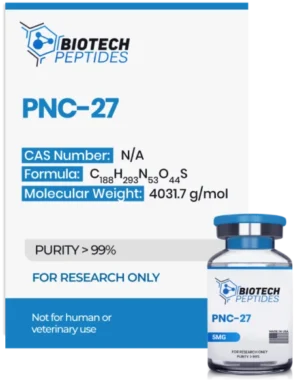
PNC-27 (5mg)
PNC-27 is a synthetic peptide initially developed for its proposed inhibitive action on cancer cell proliferation. It is a member of the PNC family of probe proteins and is designed to attach to malformed cancer cells and induce cell necrosis, but bypass normal functioning cells. The PNC-27 peptide contains the HDM2 binding domain and transmembrane domain corresponding to residue 1226 on p53. Researchers suggest that it exhibits potential to bind to and kill cancer cells through membrane lysis or cell membrane destruction. Research studies have suggested that the PNC-27 peptide may be selective in targeting specific cancer cell types, prompting further research within the context of pancreatic cancer, breast cancer, leukemia, melanoma, and other cancer strains.[1]
The PNC protein was first developed in 2000. The PNC-27 peptide appears to be a non-toxic compound, attaching to and puncturing the membranes of individual cancer cells. As a result, rapid implosion may occur, leading to immediate cell death due to differences in osmotic pressure inside and outside the tumor cells. PNC-27 appears to have this potential through an affinity for binding to a protein called HDM2. Cancer cells typically display HDM2 in their cell membranes.[2] According to the researchers “PNC-27 targets HDM-2 in the membranes of cancer cells, allowing it to induce membranolysis of these cells selectively.” Immediately after exposure to the PNC-27 peptide, studies have observed that the peptide appears to move to HDM2. Binding to them creates pores or holes in the cell membrane, causing “membrane lysis” or death of the cell membrane. This process, in turn, may lead to the destruction of cancer cells. Research is ongoing.
$142.00 -
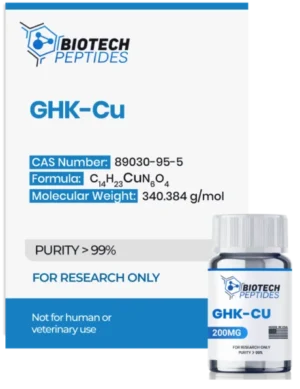
GHK-Cu (200mg)
GHK-Cu (Copper Tripeptide) is a tripeptide that scientists assert is naturally present in blood plasma. It has a sequence of Gly-His-Lys (glycine, histidine, and lysine,) which readily binds with copper to form the copper tripeptide. Scientific studies carried out in different research laboratories worldwide have explored its various biological roles. GHK-Cu exhibits some potential to influence various biological pathways, including an apparent induction of tissue repair, attraction of immune cells, antioxidant and anti-inflammatory characteristics, activation of collagen and glycosaminoglycan synthesis in skin fibroblasts, regulation of extracellular matrix components like decorin, and possible promotion of blood vessel growth. Recent studies indicate its potential role in stem cell biology and anti-tumor research as well.
$186.00 -