support@biotechpeptides.ca
-

Retatrutide (6mg)
AMP-3P 6mg is a ≥ 99 % pure triple-agonist peptide supplied as a lyophilized
powder.$55.00 -
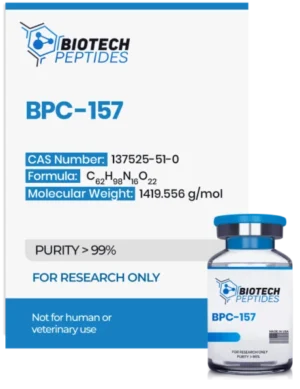
BPC-157 (5mg & 10mg)
Specifications
Molecular Formula: C62H98N16O22
Molecular Weight: 1419.556 g/mol
Sequence: L-Valine,glycyl-L-alpha-glutamyl-L-prolyl-L-prolyl-Lprolylglycyl-L-lysyl-L-prolyl-L-alanyl-L-alpha-aspartyl-L-alpha-aspartyl-L-alanylglycyl-L-leucyl-;glycyl-L-alpha-glutamyl-L-prolyl-L-prolyl-L-prolylglycyllysyl-L-prolyl-L-alanyl-L- alpha-aspartylL-alpha-aspartyl-L-alanylglycyl-L-leucyl-L-valine
Price range: $52.00 through $92.00BPC-157 (5mg & 10mg)
Price range: $52.00 through $92.00 Select options This product has multiple variants. The options may be chosen on the product page -
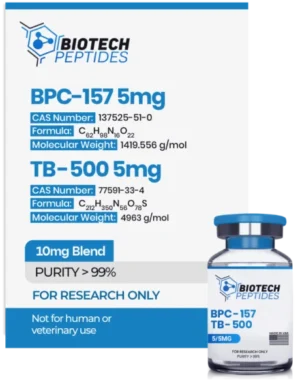
BPC-157 & TB-500 Blend (10mg)
BPC-157 and TB-500 peptides have both been examined in research on tissue repair processes, although study findings indicate that the compounds may use different biochemical pathways to achieve this potential. Researchers also hypothesize that the two molecules may exhibit synergistic effects in the healing process when exposed in combination.[1] The synergistic effect of the blend may improve the overall flexibility and adjustability of the tissues following damage.
$115.00 -
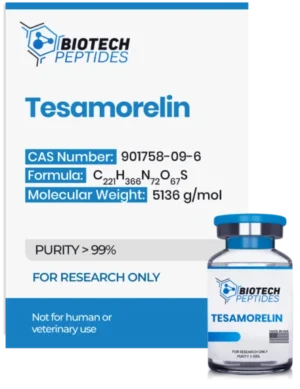
Tesamorelin (5mg & 10mg)
Tesamorelin is a chemically altered growth hormone-releasing hormone (GHRH) analog, that similar to the original is made of 44 amino acids. This peptide is a trans-3-hexanoic acid version of natural GHRH. The trans-3-hexanoic acid group is added to the N-terminus, while the C-terminus is amidated and acetylated. Tesamorelin appears to mediate the positive influence of GHRH and other GHRH analogs such as GRF (1-29), CJC-1295, and Sermorelin. The trans-3-hexanoic acid modification may increase its stability and half-life. Both Tesamorelin and CJC-1295 appear to maintain the physiological activity of GHRH, without disrupting the physiological rhythm of GH release.
Price range: $38.00 through $73.00Tesamorelin (5mg & 10mg)
Price range: $38.00 through $73.00 Select options This product has multiple variants. The options may be chosen on the product page -
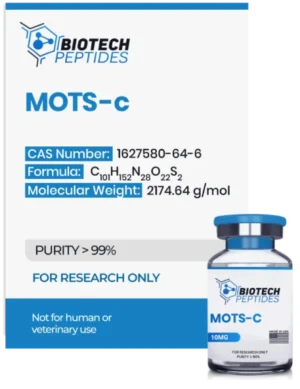
MOTS-c (10mg)
MOTS-c (mitochondrial open-reading-frame of the 12S rRNA-c) is a 16 amino acid peptide classified as a Mitochondrial-Derived Peptide (MDP), aka “mitochondrial hormone” or “mitokine.” Recent research indicates that MOTS-c is a bioactive peptide closely associated with mitochondrial communication and energy regulation. Initially, researchers hypothesized that it might be most active in the mitochondria, however recent studies suggest otherwise, that MOTS-c may operate via the bloodstream, exhibiting a potentially systemic action.
It is important to note that MOTS-c is a newly identified MDP. Its primary roles are under investigation, but studies include MOTS-c peptide’s influence in cell function and longevity, muscle contractile force, metabolic function and weight regulation.
$99.00 -
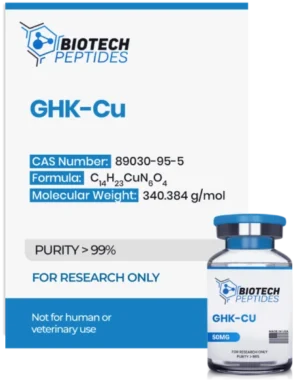
GHK-CU (Copper) (50mg)
Specifications
Molecular Formula: C14H23CuN6O4
Molecular Weight: 340.38 g/mol
Sequence: Gly-His-LysCu.xHAc
$64.00 -
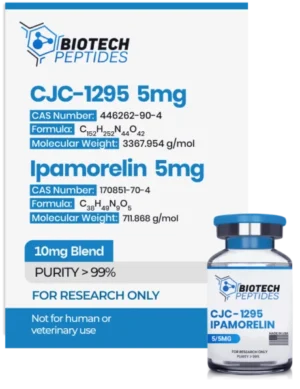
CJC-1295 & Ipamorelin Blend (10mg)
Ipamorelin is a growth hormone (GH) secretagogue that has been extensively studied in the diverse biological milieu. It is considered by researchers to be one of the most selective secretagogues and is an apparent agonist of the growth hormone/ghrelin secretagogue receptor.[1] This potential selectivity is attributed to the fact that Ipamorelin does not appear, in any way, to affect the secretion of other pituitary hormones. These include prolactin, follicle-stimulating hormone (FSH), luteinizing hormone (LH), thyroid-stimulating hormone (TSH), or Adrenocorticotropic hormone (ACTH). Ipamorelin appears to act via the molecular mimicry of the natural hormone ghrelin, which triggers and stimulates the release of the growth hormone.[2] This whole process may be regulated by a negative feedback mechanism, which may nullify any ancillary impacts of excess GH production. Researchers suggest that Ipamorelin may impact all physiological processes in which ghrelin is active. Based on their observations, researchers have suggested that Ipamorelin may improve bowel movement and gastric function, enhancing the development and repair of muscles, facilitating the release of insulin hormone from the pancreas, and stimulating the growth of bones. In addition to these potentials, Ipamorelin may also be involved in cellular repair and increased collagen production.[3] It has also been hypothesized that the peptide may act to improve cognitive function and sleep cycle regulation.
$81.00 -
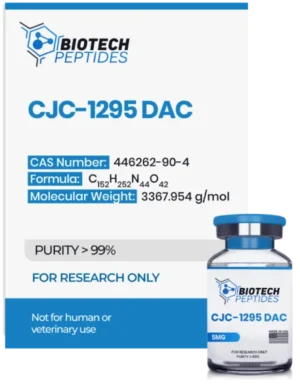
CJC-1295 DAC (5mg)
Specifications
Other Known Titles: CJC-1295 with DAC
Molecular Formula: C152H252N44O42
Molecular Weight: 3367.954 g/mol
Sequence: H-Tyr-D-Ala-Asp-Ala-Ile-Phe-Thr-Gln-Ser-Tyr-Arg-Lys-Val-Leu-Ala-Gln-Leu-Ser-Ala-Arg-Lys-Leu-Leu-Gln-Asp-Ile-Leu-Ser-Arg-Lys(Mal)-NH2
$52.00 -
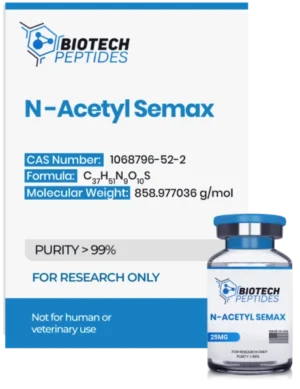
N-Acetyl Semax (25mg)
N-Acetyl Semax is posited to be an acetylated form of the Semax peptide. The peptide consists of a 4 amino acid fragment (Met-Glu-His-Phe) from the chain of melanocortin hormones. These include the adrenocorticotropic hormone (ACTH) and a Pro-Gly-Pro fragment. The integration of Pro-Gly-Pro (PGP) into N-Acetyl Semax may potentially enhance the permeability of the peptide through the blood-brain barrier (BBB). This enhancement might occur by increasing the peptide’s lipophilicity, thereby potentially improving passive diffusion or uptake via lipid raft-mediated endocytosis.
This process may hypothetically allow the peptide to bypass the BBB’s tight junctions, which researchers claim are usually highly restrictive. Adding PGP at the C-terminus might also modify the peptide’s interactions with specific BBB transporters or receptors, possibly facilitating receptor-mediated transcytosis. Receptor-mediated transcytosis is a process where substances are transported across cells via specific receptors, and alterations at the C-terminus might influence this pathway.
Researchers have noted that the acetylation of the peptide into N-Acetyl Semax appears to reduce the affinity of other ions, such as Cu++, to its N-terminus.[1] Acetylation may contribute to an increase in the peptide’s resistance to enzymatic degradation, potentially leading to an extended half-life observed in experimental models. Increased resistance to degradation might mean that the peptide potentially remains active for a longer period, which may enhance its stability.
$57.00 -
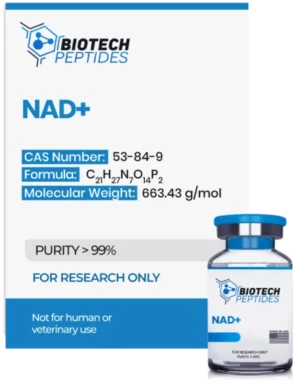
NAD+ (100mg & 500mg)
Nicotinamide Adenine Dinucleotide (NAD+) is an oxidized form of NADH (Nicotinamide Adenine Dinucleotide Hydroxide). NAD+ is a component of the Electron Transport Chain (ETC), which researchers have suggested to act in carrying electrons and thus energy within cells. The peptide has also been posited to potentially act as a mediator for various physiological processes, such as post-translational modification of the proteins and activation/deactivation of some enzymes. It is believed to be a critical component in maintaining cell-to-cell communication.
Price range: $46.00 through $179.00NAD+ (100mg & 500mg)
Price range: $46.00 through $179.00 Select options This product has multiple variants. The options may be chosen on the product page -
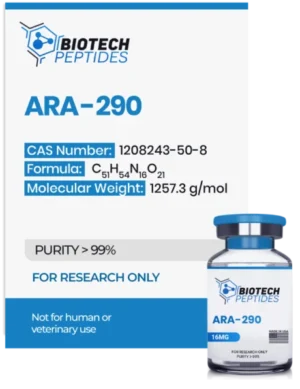
ARA-290 (16mg)
Erythropoietin (EPO) is a kidney-derived glycoprotein made of 11 amino acids that has been studied for its potential to promote blood vessel growth and repair, and possible neuroprotection in the case of diabetic neuropathy. ARA-290 is a peptide derived from the beta-helix domain of EPO.[1] ARA-290 was developed with the intention of stimulating pain-mitigating and neuroprotective activity of EPO, though without promoting blood cell formation. ARA-290 has been proposed by researchers to exhibit anti-apoptotic, anti-inflammatory, and anti-permeability characteristics, akin to the endogenous glycoprotein, EPO. The peptide is being evaluated for its potential in neuropathic wound healing, immunomodulation, and within the context of Systemic Lupus Erythematosus (SLE) research.
$88.00 -
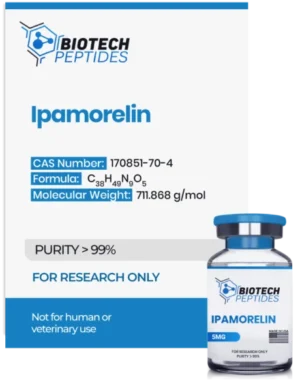
Ipamorelin (5mg)
Ipamorelin is a small pentapeptide that binds to the receptor of ghrelin/growth hormone secretagogue (GHS), and is speculated to trigger the release of growth hormone via pituitary cells. Research has suggested the peptide to be selective in its mode of action.[1] Ipamorelin, researchers report, does not appear to induce non-specific release of hormones like prolactin, thyroid-stimulating hormone, ACTH, luteinizing hormone, follicle-stimulating hormone, or cortisol. The high specificity of the peptide makes it an ideal model for the study of selectivity in receptor binding. It appears to function through interaction with cognate receptors on the target cell surface and mediates a cellular response. Ipamorelin may induce secretions from the pituitary gland, promoting growth in animal study models.[2] In addition, it may not only trigger the expression of insulin-like growth factor-1(IGF-1) but may also inhibit the secretion of somatostatin. IGF-1 is considered to be the main anabolic mediator of growth hormone.
$46.00 -
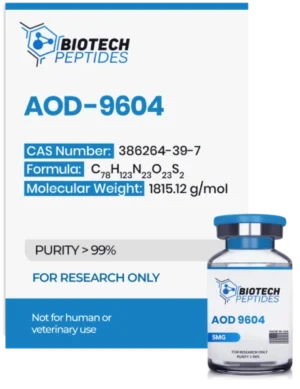
AOD 9604 (5mg)
Specifications
Other Known Titles: AOD-9604
Molecular Formula: C78H123N23O23S2
Molecular Weight: 1815.1 g/mol
Sequence: Tyr-Leu-Arg-Ile-Val-Gln-Cys-Arg-Ser-Val-Glu-Gly-Ser-Cys-Gly-Phe
$44.00 -
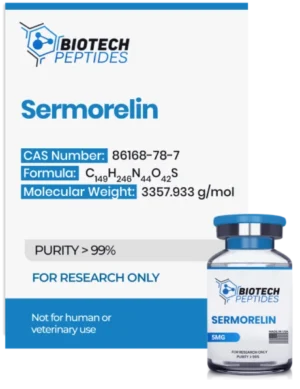
Sermorelin (5mg)
Sermorelin is among the growth hormone-releasing hormone (GHRH) analogs. It is classified as a GHRH as researchers have suggested that the peptide acts to induce the endogenous production and release of growth hormone (hGH). Growth hormone has been associated with numerous physiological activities, making Sermorelin and other GHRH analogs, potentially relevant in growth hormone-related research. Examples of studies employing GHRH analogs include research in the context of tissue scarring following cardiac dysfunction, as well as those examining bone density, renal function, dementia and seizure activity.
$43.00 -
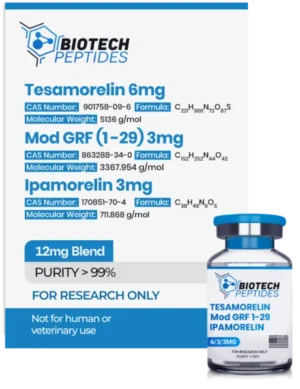
Tesamorelin & CJC-1295 (Mod GRF 1-29) & Ipamorelin Blend (12mg)
Tesamorelin & CJC-1295 (Mod GRF 1-29) & Ipamorelin peptide blend is a combination of peptides that may potentially interact with receptors in the pituitary gland. This blend may activate pituitary cells responsible for growth hormone (hGH) production.
Tesamorelin is a synthetic peptide that appears to act as an analog for growth hormone-releasing hormone (GHRH).[1] It may potentially interact with specific receptors in the pituitary and the hypothalamus, known as GHRH receptors. The activation of these receptors appears to trigger a release of growth hormone from pituitary cells.
Mod GRF (Modified Growth Hormone-Releasing Factor), also known as CJC-1295 without DAC (Drug Affinity Complex), is a synthetic peptide analog of the endogenous growth hormone-releasing hormone (GHRH).[2] It is a tetrasubstituted version of the shortest GHRH sequence. The peptide may potentially trigger GHRH receptors – GRF (1-29). It appears to bind to GHRH receptors in the pituitary cells associated with the release of hGH.
Ipamorelin is another synthetic peptide that may interact with pituitary cells, although it appears to do so by triggering a different receptor called the growth hormone secretagogue (GHS) receptor.[3] These receptors, also called ghrelin receptors, are apparently found in the pituitary and the hypothalamus. By activating these receptors in an organism’s brain, Ipamorelin may potentially trigger the synthesis of HGH by pituitary cells.
$109.00