support@biotechpeptides.ca
-
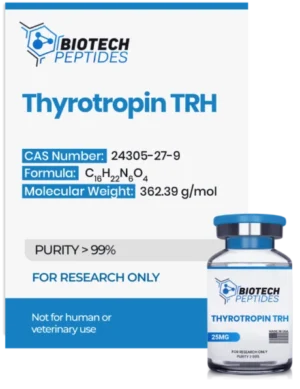
TRH Thyrotropin (Protirelin) (25mg)
Thyrotropin Releasing Hormone (TRH), often called Protirelin, is a small peptide hormone made of 3 amino acids and synthesized in the hypothalamus. The hormone is thought to function via binding to the thyrotropin-releasing hormone receptors TRH-1 and TRH-2. It was developed by researchers with the intention to stimulate the release of both thyroid-stimulating hormone (TSH) and prolactin from the anterior pituitary. TSH, in turn, acts directly on the thyroid gland to promote the synthesis and release of thyroid hormones, primarily triiodothyronine (T3) and thyroxine (T4). TRH has been employed in the study of anterior pituitary gland function in models of thyroid disorders. TRH may exhibit potential roles in TREK-1 channel, in the regulation of cellular aging, arousal, feeding behaviors, autonomic regulation, and mitigating free radical damage.
$93.00 -
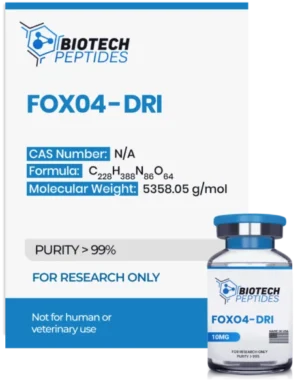
FOXO4-DRI (Proxofim) (10mg)
FOXO4-DRI is a synthetic version of FOXO4, containing D amino acids instead of L amino acids. This modification is intended to allow the peptide to retain the functionality of the original protein but with a longer shelf life and lower clearance. Its most prominent function has been suggested to regulate apoptosis in senescent cells.[1] It has been suggested in scientific studies that senescent cells might exhibit resistance to apoptosis, aka programmed cell death. This resistance has been associated with increased binding of FOXO4 with another protein, p53, which should trigger apoptosis but become inactivated.
$270.00 -
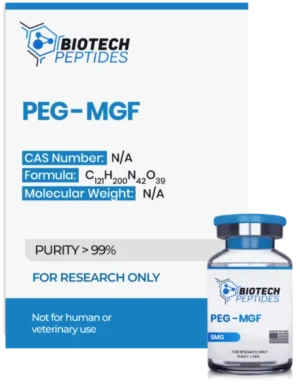
PEG-MGF (Pegylated MGF) (5mg)
Pegylated Mechano-growth factor (PEG-MGF) is a peptide that originates from the IGF-I (main anabolic mediator of growth hormone) gene sequence, which undergoes a process called alternative splicing.[1] This process allows for the synthesis of additional segments, which form new functional molecules. During stress or injury, it has been suggested that muscles produce an alternative peptide called IGF-IEc, which contains extra “exons” or domains. This is thought to result in an additional segment at the C-terminus of IGF-I, known as the Ec-peptide, which comprises 40 amino acids.[2]
MGF, or mechano-growth factor, is a synthetic peptide that represents the last 24 amino acids from the naturally occurring IGF-IEc molecule (the Ec-peptide). This 24 amino acid fragment is also called the E-domain or MGF-E and is thought to mediate the beneficial actions of IGF-IEc on muscle recovery and cell proliferation.[5]. It appears to stimulate myoblast (muscle cell) proliferation and differentiation. It has further been researched for its potential to increase endurance, stimulate the function of the immune system, and possible applications that may decrease cholesterol. PEG-MGF may also hasten wound healing via immune function regulation. The up-regulation of IGF-IEc, sometimes referred to as full-length MGF, during periods of stress or injury has been correlated by researchers with the proliferation of satellite cells and muscle cells. This suggests a potential role in muscle tissue repair and regeneration.[3][4]
The attachment of a polyethylene glycol moiety to another chemical compound is termed “Pegylation.” Pegylation appears to increase the plasma stability of a compound like MGF by decreasing its clearance and potentially masking its immunogenicity. Pegylation may be considered a common and typically advantageous modification. MGF appears to have a shorter half-life than other peptides. With this in mind, the pegylation of the peptide may overcome any rapid clearance.
$79.00 -
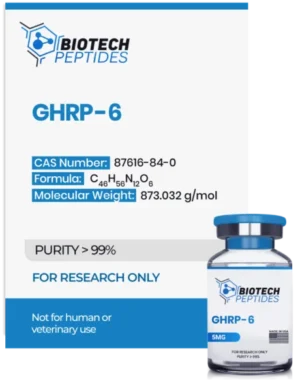
GHRP-6 (5mg)
Specifications
Molecular Formula: C46H56N12O6
Molecular Weight: 873.032 g/mol
Sequence: His-D-Trp-Ala-Trp-D-Phe-Lys
$21.00 -
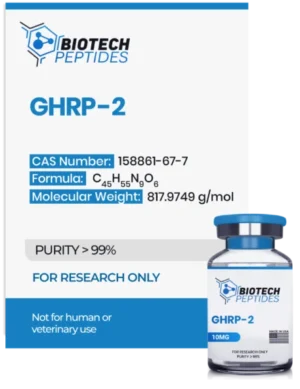
GHRP-2 (10mg)
Specifications
Other Known Titles: Thymosin Beta 4
Molecular Formula: C45H55N9O6
Molecular Weight: 817.9 g/mol
Sequence: H-D-Ala-D-2-Nal-Ala-Trp-D-Phe-Lys-NH2
$39.00 -
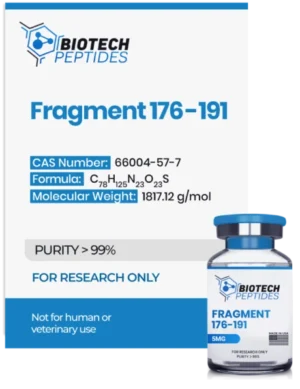
Fragment 176-191 (5mg)
Specifications
Molecular Formula: C78H125N23O23S2
Molecular Weight: 1817.1 g/mol
Sequence: Tyr-Leu-Arg-Ile-Val-Gin-Cys-Arg-Ser-Val-Glu-Gly-Ser-Cys-Gly-Phe
Other Known Titles: Frag 176-191
$44.00 -
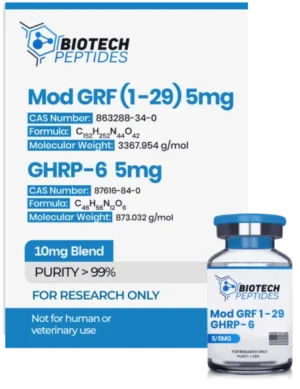
Mod GRF 1-29 & GHRP-6 (10mg)
Modified Growth Hormone Releasing Factor (Mod GRF 1-29) and Growth Hormone Releasing Peptide-6 (GHRP-6) are two peptides that researchers believe may support the secretion of growth hormone (GH) from cells in the anterior pituitary gland. The peptides may offer this support through distinct biological pathways. Mod GRF (1-29) is a synthetic peptide derived from Growth Hormone Releasing Hormone (GHRH), an endogenous hormone consisting of 44 amino acids that stimulates GH release. Some studies have indicated that the initial 29 amino acids of GHRH retain their full biological activity.[1] Modifications to this fragment, resulting in Mod GRF (1-29), are believed to increase its potency and prolong its duration of action, possibly due to better-supported stability against enzymatic degradation.
$86.00 -
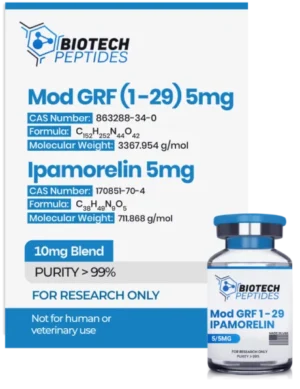
Mod GRF 1-29 & Ipamorelin Blend (10mg)
Modified GRF 1-29 and Ipamorelin are separate peptides, which research indicates may work synergistically to induce potential growth hormone release and growth hormone pulses. This increase may result in several downstream physiological activities associated with increased growth hormone release. Modified GRF 1-29 peptide is an analog of growth hormone-releasing hormone (GHRH).[1] It is also known as tetra-substituted GRF (1-29), and is composed of a sequence thought to be the smallest necessary to interact with GHRH receptors, specifically the first 29 amino acids of GHRH. On the other hand, Ipamorelin is suggested to act via binding to growth hormone secretagogue (GHS) receptors.[2] These receptors are also known as the ghrelin receptors, and Ipamorelin appears to be a highly selective pentapeptide that binds and activates them.
$81.00 -
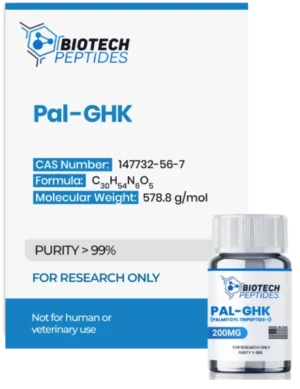
Pal-GHK (Palmitoyl Tripeptide-1) (200mg)
Pal-GHK, also known as Palmitoyl Tripeptide-1 and Palmitoyl Oligopeptide, is a synthetic peptide developed to function in protein production to support the skin’s extracellular matrix (ECM), and skin pigmentation. Pal-GHK is a synthetic hybrid peptide with one fatty acid and one peptide. “Pal” represents Palmitoyl—the covalent attachment of fatty acid to the end of the structure. “GHK” represents glycine-histidine-lysine—the peptide’s amino acid structure. This sequence is thought to be a small fraction of the large protein collagen, which is one of the main proteins in the extracellular matrix of skin and other tissues. The GHK sequence appears to be present in the “alpha 2(I) chain of type I collagen”, and researchers suggest that such a “tripeptide might be liberated by proteases at the site of a wound” as a signal of injury and thus, may be a powerful stimulant for repair.[1] Particularly, it may signal and attract fibroblasts—cells responsible for synthesizing collagen, elastin, and other proteins in the skin’s extracellular matrix, bones, and connective tissues. “Pal” represents Palmitoyl—the covalent attachment of fatty acid to the end of the structure. The addition of palmitoyl to the molecule is thought to result in better penetration through skin cells and, more specifically, stratum corneum.
$119.00 -
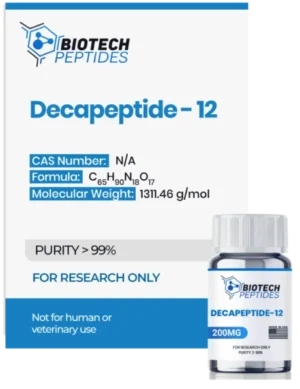
Decapeptide-12 (200mg)
Decapeptide-12 is an oligopeptide with proposed anti-tyrosinase activity, composed of twelve amino acids and exhibiting the sequence Try-Arg-Ser-Aar-Lysd-Tyr-Ser-Ser-Trp-Tyr. It is thought to function primarily to restrain Tyrosinase—the enzyme researchers believe is responsible for the excessive production of melanin, which may result in patchy pigmentation upon the epidermal layer’s surface.
$226.00 -
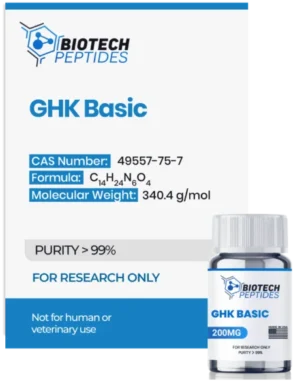
GHK Basic (Tripeptide-1) (200mg)
GHK is an endogenous copper peptide that occurs in the tripeptide glycyl-L-histidyl-L-lysine. It has two variants — GHK with or without Cu (Copper). GHK appears to have a strong affinity for copper (II), and it is synthesized from plasma, although it has been isolated in other areas. Endogenous GHK production is considered to decline over time. [1]
In cases of injury, GHK may be released from tissue cells. That may be because GHK is present in various proteins that get broken down via hydrolysis during injury. For example, studies suggest that GHK is present in the “alpha 2(I) chain of type I collagen”, which “suggests that the tripeptide might be liberated by proteases at the site of a wound and exert in situ healing.” [2] GHK peptide may also be released from the breakdown of another extracellular matrix-binding protein involved in regulating cell shape and proliferation, called SPARC (Secreted Protein, Acidic, and Rich in Cysteine). GHK is found in tissues undergoing remodeling, such as during the process of angiogenesis.[3]
When GHK is released from the breakdown of proteins like collagen and SPARC, this signaling appears to trigger the fibroblasts to begin synthesizing new collagen and other structural proteins in the skin structure and connective tissues like elastin and glycosaminoglycan. Further, this copper-binding peptide appears to affect genes that control recuperative responses to injury and stress. Its functions appear to include the following: tissue remodeling, anti-inflammatory response, pain perception inhibition, nootropic, anti-cancer action, blood vessel growth, and nerve outgrowth.
$165.00 -
-
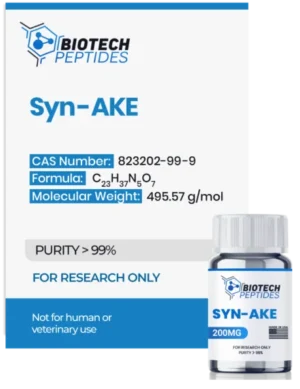
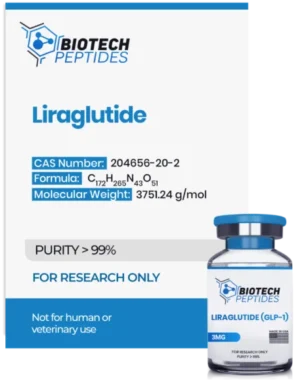
Syn-AKE (200mg)
Syn-AKE is a peptide, also known as tripeptide-3 or dipeptide diaminobutyroyl benzyl amide diacetate. Syn-AKE, a synthetic peptide ingredient, appears to mimic the actions of the Waglerin-1 peptide, which is 21 amino acids in length. Waglerin-1 functions primarily as a muscle relaxant by inhibiting the activity of acetylcholine at the neuromuscular junction, which may potentially result in reduced muscle contractions. Acetylcholine is a neurotransmitter considered essential for muscle movement, and its inhibition at the neuromuscular junction prevents the normal contraction signals from reaching muscles. In the development of Syn-AKE, researchers sought to synthesize a peptide that might potentially mimic this action. Thus, the peptide Syn-AKE was engineered to emulate the mechanism by which Waglerin-1 acts, but in a more selective manner. Researchers suggest Syn-AKE may act to reduce transmission between muscles and nerves, working similarly to botulinum toxin to relax muscles and thus reduce instances of creasing and wrinkle development along epidermal surfaces, as suggested in animal model research. The apparent reduction of this transmission appears to be reversible when triggered by Syn-AKE. Therefore its action is temporary.[1] According to Pentapharm, “the Syn-AKE invokes its action by blocking the muscle nAChR in a reversible manner by blocking the ion channel. As a result, the Na+ uptake is substantially disturbed, and the muscles remain relaxed.”
$210.00 -
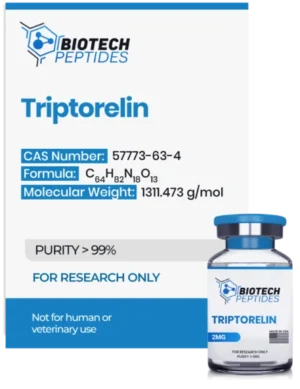
Triptorelin (GnRH) (2mg)
Triptorelin is a synthetic analog of gonadotropin-releasing hormone (GnRH), potentially mimicking the structure and function of the natural hormone. It may bind to GnRH receptors, initially stimulating the hypothalamic-pituitary-gonadal (HPG) axis, leading to a temporary surge in luteinizing hormone (LH) and follicle-stimulating hormone (FSH) levels. In turn, LH and FSH are thought to stimulate endocrine cells, like testicular cells that produce testosterone (T). However, with prolonged exposure, Triptorelin appears to desensitize the GnRH receptors, resulting in suppressed production of LH and FSH, thereby apparently reducing testosterone and estrogen levels. This potential mechanism has been extensively researched in models of androgen deprivation, exploring its potential in various contexts such as prostate cancer cells and receptor-positive breast cancer cells.
$36.00 -
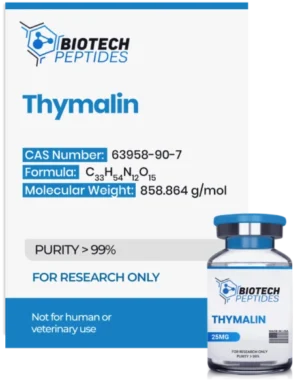
Thymalin (25mg)
Thymalin, sometimes referred to as Thymalin Alpha-1, is the synthetic variant of the endogenous Thymulin, which was first isolated from the thymus in 1977. The endogenously produced Thymalin has been researched for its potential in a wide landscape of research areas, with its influence speculated to extend to regulatory action on inflammation, mitigation of pain perception, neuroprotective action, and immune function support. Early studies have suggested that Thymalin and other thymus and pineal gland secretions may also support cell longevity.
$114.00