support@biotechpeptides.ca
-
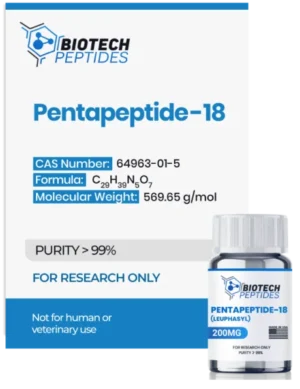
Pentapeptide-18 (Leuphasyl) (200mg)
Pentapeptide-18 (Leuphasyl) is a modified analog of the naturally occurring pentapeptide leu-enkephalin, which is part of a class of peptides called enkephalins which are believed to directly interact with opioid receptors.[1] Structurally, Pentapeptide-18 differs from leu-enkephalin by the addition of D-Alanine in place of glycine at its second position. Pentapeptide-18 is thought to penetrate the epidermal barrier and influence cellular processes that affect muscle cell contraction. Studies suggest that it acts by modulating calcium release in neuronal synapses. By interfering with the signals that trigger muscle contraction, Pentapeptide-18 may help to relax muscles, reducing the formation of fine lines and wrinkles across the skin barrier. Additionally, modified versions of Pentapeptide-18 may interact with melanin production pathways, which is a pigment responsible for adding color to tissues and may play a protective role against UV radiation. By potentially influencing melanin synthesis, modified versions of Pentapeptide-18 may offer research value in skin tissue studies.
$215.00 -
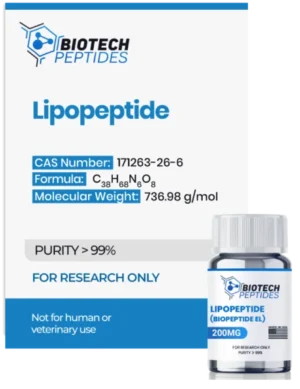
Lipopeptide (Biopeptide EL) (200mg)
Lipopeptide is a common name for Biopeptide EL, also known as palmitoyl hexapeptide-12. As the name suggests, this peptide is made of six amino acids and has a palmitic fatty acid addition. The inclusion of palmitic acid within the Lipopeptide structure is thought to enhance penetration to the deeper layers of various structures made of skin cells. The amino acids in the peptide are valine-glycine-valine-alanine-proline-glycine (VGVAPG), and the sequence is one of the most common found in naturally occurring proteins like elastin and its precursor, tropoelastin.
By mimicking fragments of elastin, the peptide is thought to interact with fibroblast cells and exert a potential impact on the production of vital proteins to the skin’s extracellular matrix (ECM). Fibroblasts are a subset of cells found in connective tissue, such as the one that provides support for skin cells. Fibroblasts can actively produce ECM proteins, and some of the most important proteins are considered to be collagen, elastin, and hyaluronic acid. According to scientific research, Lipopeptide may potentially enhance the creation and growth of collagen and hyaluronic acid within the ECM.
$220.00 -
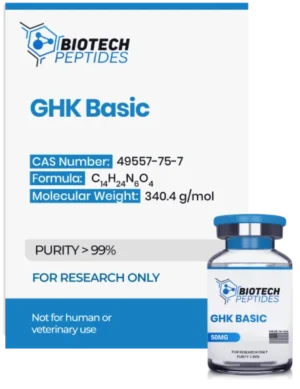
GHK Basic (50mg)
GHK is a copper peptide that occurs naturally in a copper complex of the tripeptide glycyl-L-histidyl-L-lysine. It has two variants — GHK with or without Cu. GHK appears to have a strong affinity for copper (II), and it is synthesized naturally from plasma, although it has been isolated in other areas. In cases of injury, GHK may be released from tissue cells. The copper peptide appears to affect genes that control injury and stress responses. Its functions appear to include the following: tissue remodeling, anti-inflammatory response, pain perception inhibition, nootropic action anti-cancer action, blood vessel growth, and nerve outgrowth. A decrease in the regenerative capacity of an organism may be traced to a decline in GHK-level. Its potential functions extend to infection control, follicle growth, collagen and elastin production increases, tissue repair, and glycosaminoglycan synthesis. Endogenous GHK production is considered to decline over time.
$51.00 -
-
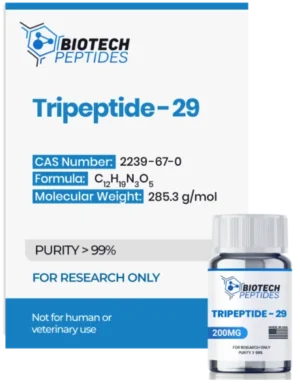
Tripeptide-29 (200mg)
Tripeptide-29 is a peptide that is one of the basic monomers of collagen. Collagen is a long-chain polymer composed of short monomers made of three consecutive amino acids. These monomers combine to form a secondary structure, which then may form tertiary and even quaternary structures. These complex structures may have many potential emergent properties. For example, most collagen molecules are thought to play roles in providing structural integrity and elasticity to the cellular complexes in tissues like the stratum corneum, tendons, and bones.
Collagen subunits most often follow the pattern of Gly-Pro-X, Gly-Xo-X, or Gly-X-Hyp. Tripeptide-29 is a GlyPro Hyp peptide, a complete synthetic analog of common collagen building blocks. Beyond its proposed involvement in collagen synthesis, researchers speculate that Tripeptide-29 may have additional biological implications. For instance, some preliminary studies suggest it may act as an antioxidant, potentially aiding in the protection of cells against oxidative stress, which is the imbalance between free radicals and antioxidants that may lead to cellular damage.
It is hypothesized that Tripeptide-29 might exhibit anti-inflammatory properties, possibly reducing inflammation; anti-fibrotic actions, which may help mitigate excessive formation of fibrous connective tissue; and anti-melanogenic characteristics, potentially influencing melanin production and affecting pigmentation processes in the dermal and epidermal layer.
$189.00 -
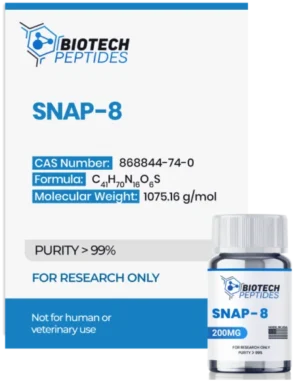
SNAP-8 (200mg)
SNAP-8, or Synaptosomal-associated protein 8, is a synthetic octapeptide believed to mimic certain functionalities of its larger counterpart, SNAP-25, a protein deemed integral to neurotransmitter release and muscle contraction.[1] Constructed from eight amino acids, SNAP-8’s structure is designed with specific modifications: an acetylated N-terminus and an amidated C-terminus, culminating in the sequence Ac-Glu-Glu-Met-Gln-Arg-Arg-Ala-Asp-NH2. It is structurally similar to another peptide known as acetyl hexapeptide-3, which also reportedly mimics a fragment of SNAP-25 and inhibits its function, leading to similar anti-wrinkle potential. By adding two amino acids to the chain of acetyl hexapeptide-3, the resultant acetyl octapeptide further enriches the field of research compounds studying cell aging and skin cell rejuvenation.[2]
The synthesis and manufacturing of SNAP-8 comprises a final freeze-drying step called lyophilization. Generally, the crystalline powder obtained due to freeze-drying is in the form of a polymorphous compound. It may be present in aggregates and show variation in the crystal size. However, this does not appear to lead to any chemical discrepancy in its composition. Extensive experimental studies have supported the homogeneity of this compound. The usual shelf life of SNAP-8 is posited to be at least 12 months, provided the compound is stored in a clean, cool, and dry place. If the compound is intended to be stored longer than a year, the temperature should be maintained at 4 degrees Celsius. This may extend the shelf life to approximately 18 months. Refrigeration of the SNAP-8 may potentially lead to its precipitation; however, this doesn’t appear to change the integrity of the compound.
$172.00 -
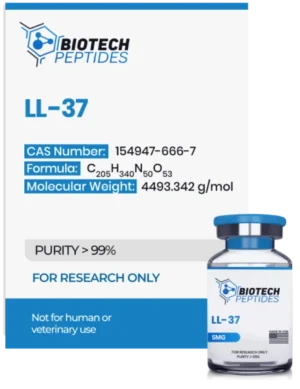
LL-37 (5mg)
LL-37 is a Cathelicidin, a protein family of unique and diverse functions. These peptides, produced by macrophages and polymorphonuclear leukocytes (both types of white blood cells), have been suggested to exhibit bactericidal action. The entire group is classified as antimicrobial peptides (AMPs). The peptide, in particular, has been researched in relation to autoimmune disease, cancer, and wound recovery.[1] For example, researchers note that “Corneal and conjunctival epithelia express LL-37 as part of mucosal innate immunity to protect against bacterial and viral ocular infections.”
$86.00 -
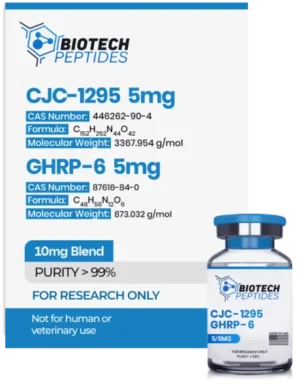
CJC-1295 & GHRP-6 Blend (10mg)
The CJC-1295 & GHRP-6 blend have been posited by researchers to display a synergistic action on cells that participate in the release of growth hormone. More specifically, the mix includes CJC-1295, which appears to be similar in action to growth hormone-releasing hormone (GHRH), and GHRP-6 (Growth Hormone Releasing Peptide 6), which appears to bind to the receptors of the hunger hormone ghrelin.This combination of peptides may possibly increase both the strength and the number of growth hormone signals from somatotroph cells. CJC-1295 appears to target the GHRH receptor pathway, while GHRP-6, is considered by researchers to act on the ghrelin receptor pathway. This may explain why the combination of CJC-1295 and GHRP-6 exhibits potential to interact with somatotroph cells in the pituitary gland and the hypothalamus. Both of these regions in the central nervous system are considered to be comprised of cells that are believed to be important in making and controlling growth hormone synthesis.
$86.00 -
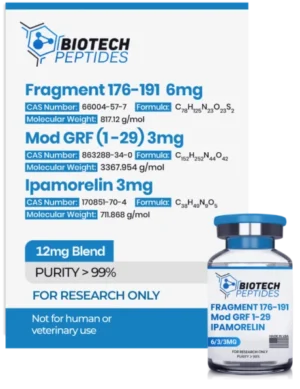
Fragment 176-191 & Mod GRF 1-29 & Ipamorelin Blend (12mg)
Studies have suggested that a maximal output of endogenous growth hormone (GH) from the anterior pituitary gland might be attained through a combination of growth hormone-releasing hormone (GHRH) analog and agonist of growth hormone secretagogue receptor (GHSR).[1] The combination of Ipamorelin with Modified GRF is one of the various combinations researchers have studied in an effort to achieve maximal growth hormone production. Interestingly, more specific results appear to be achieved beyond the increase in GH synthesis by refining the choice of GHRH and GHSR evaluated in a particular study. Modified GRF, which researchers have suggested may be a potent GHRH analog, may have impacts beyond growth hormone release. It has been speculated to impact intestinal inflammation, tissue repair, and cardiac function in addition to researchers’ suppositions on its impact on growth hormone release. Ipamorelin, classified as a growth hormone secretagogue, appears to interact with the GHSRs, also known as ghrelin receptors, and may have the potential to impact bone growth. Activating the ghrelin receptors may affect appetite, to increase food consumption and total weight gain. Depending on the desired outcome of the particular study, namely the addition or reduction of weight, this specific receptor activity may be mitigated by adding lipolytic molecules, which may help minimize the possibility of fat increase. Fragment 176-191 is often combined with Ipamorelin and other research peptides. The peptide known as Fragment 176-191, also referred to as hGH Fragment 176-191, Frag 176-191, tyr-hGH 177-191, or AOD-9604, is hypothesized to specifically target the fat-reduction pathways of growth hormone. This peptide consists of a sequence of 16 amino acids derived from the terminal portion of the growth hormone molecule, identified by researchers as the “lipolytic fragment” due to its potential fat-burning capabilities. The term ‘lipolytic’ describes the fragment’s capacity to promote fat breakdown. To enhance the peptide’s stability, the initial amino acid in the hGH Fragment 176-191 sequence is substituted with tyrosine, leading to its alternate designation as Fragment tyr-hGH 177-191.
$87.00 -
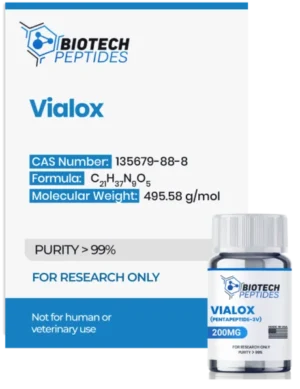
Vialox (Pentapeptide-3V) (200mg)
Vialox, also known as Pentapeptide-3V, is a peptide with a five amino acid sequence (Gly-Pro-Arg-Pro-Ala). It was originally isolated from endogenously produced snake venom. The peptide appears to replicate temporary muscular paralysis. This result has been observed by researchers in paralytic compounds such as botulinum toxin, which are believed to reduce wrinkle depth. Vialox appears to inhibit nicotinic acetylcholine receptors. This potential may enable curare-like actions at the neuromuscular junction, which might block nervous system electrical impulses from reaching muscles. A block like this may ultimately halt muscle contraction.
This mechanism appears to be analogous to the function of tubocurarine. This function is observed through Vialox’s hypothetical interaction with acetylcholine receptors on the postsynaptic membrane of muscle cells. Tubocurarine, a naturally occurring alkaloid compound, is primarily found in the bark of certain plants. This includes Chondrodendron tomentosum, commonly referred to as “curare.” Experts recognize this compound as a potent neurotoxin. Its mode of action is considered to function as a non-depolarizing neuromuscular blocker. It is hypothesized that this function obstructs the activity of acetylcholine—a neurotransmitter deemed by researchers to be critical for muscle contraction—at the neuromuscular junction, which might inhibit muscle contraction.
$210.00 -
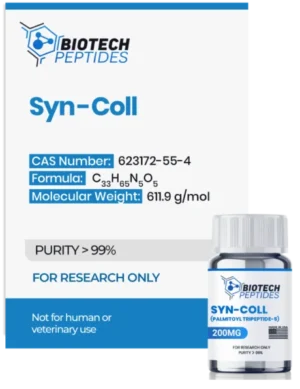
Syn-Coll (Palmitoyl Tripeptide-5) (200mg)
Syn-Coll, otherwise known as Palmitoyl Tripeptide-5 or Tripeptide-5, is a synthetic peptide that was developed to enhance the production of type I collagen. It appears to repair damages caused by photo-aging, and Syn-Coll has also been suggested to support the regeneration of skin protein production, such as elastin or collagen. Syn-Coll (Palmitoyl Tripeptide-5) is the synthetic equivalent of Thrombospondin 1 (TSP-1). TSP-1 is an extracellular matrix protein and is found in the skin near collagen and elastin. Syn-Coll appears to mimic the functions of TSP-1, possibly aiding in the prevention of collagen degeneration via stimulating the release of TGF- induced by TSP-1.[1] TGF-β is an essential growth factor potentially significant in preserving skin integrity and facilitating the development of skin structures, mainly through the promotion of collagen synthesis. Additionally, Syn-Coll, a synthetic peptide, has been the subject of extensive research in animal models and laboratory experiments. The findings tentatively indicate that Syn-Coll might enhance collagen production and potentially inhibit its degradation. The inhibition of collagen breakdown by Syn-Coll is possibly due to its ability to suppress the activity of matrix metalloproteinases (MMPs), including MMP1 and MMP3, which are enzymes studied for their role in the degradation of collagen in the skin. The peptide is palmitoylated, to potentially extend its bioavailability in experiments involving different skin tissue models.
$217.00 -
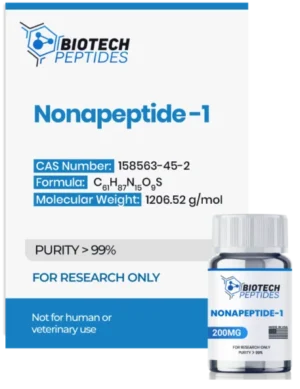
Nonapeptide-1 (200mg)
Nonapeptide-1, also termed Melanostatine-5, is a peptide that may prevent the activation of pigment-producing cells in the skin called melanocytes. It appears to be one of the most potent inhibitors of a receptor found in these pigment-producing cells, called the melanocortin-1 receptor (MC1R). Researchers have explored a peptide library containing 31,360 structurally different compounds, and it appears that the most potent inhibitor identified was Met-Pro-D-Phe-Arg-D-Trp-Phe-Lys-Pro-Val-NH₂, aka Nonapeptide-1.[1] Structural analysis has revealed that specific amino acids, such as D-Trp at position 5 and Phe at position 6, are considered crucial for their antagonistic potential. The presence of D-Phe at position 3 further underscores such potential. Research on animal models suggests that Nonapeptide-1 may inhibit the synthesis of melanin, bringing it to the forefront of research on conditions impacting skin pigmentation, such as melasma. Studies in animal models posit that Nonapeptide-1 may reduce the synthesis of melanin and potentially decrease pigmentation on a considerable scale.
$210.00 -
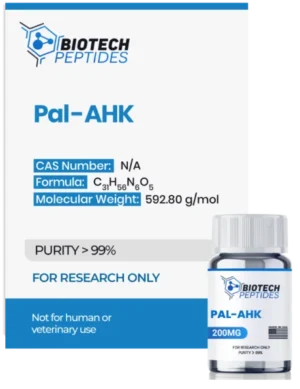
Pal-AHK (200mg)
Pal-AHK, also referred to as Palmitoyl Tripeptide-3, is a tripeptide with a fatty acid attachment. It consists of amino acid sequences (alanine-histidine-lysine) and appears to be attached to a Palmitoyl fatty acid molecule. The fatty-acid component of AHK makes it lipophilic (soluble in fat), which may increase the potential of the peptide for penetration and absorption by epidermal cells in experimental models while maintaining the same mechanisms of action as regular AHK. AHK appears to be a multifunctional copper-binding peptide that has been studied for its potential role in supporting cellular functions related to the kin’s extracellular matrix.
Research indicates that AHK-Cu may increase the proliferation and viability of dermal fibroblasts—the primary cells responsible for producing collagen and other essential proteins in the extracellular matrix (ECM).[1] Moreover, the peptide appears to possess significant antioxidative potential compared to other tripeptides when investigated via chromatographic evaluations. This appears to be related to its potent metal-chelating properties.
$180.00 -
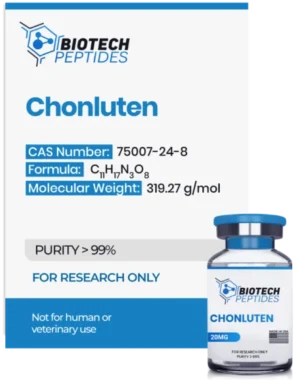
Chonluten (T-34) (20mg)
Chonluten is also known as Tripeptide T-34 or EDG, due to its sequence (Glu-Asp-Gly). It is a cytogenetic complex consisting of short peptides that are suggested to normalize the mucous membrane cells of the lungs and the bronchial tube. It is a gene regulator associated with inflammation and antioxidant activity, and is considered to be involved in proliferation responses.[1] It appears to function in animal test models as an anti-inflammatory in the lungs, normalizing the mucosal functions of the lungs in conditions like asthma and chronic obstructive pulmonary disease (COPD).
$62.00 -
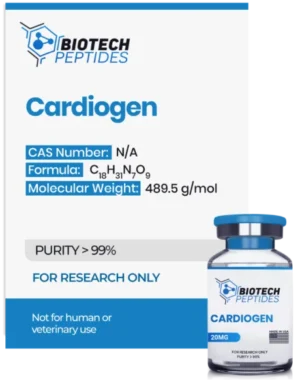
Cardiogen (20mg)
Cardiogen is a cardiovascular bioregulator peptide complex. Results obtained from research studies suggest that Cardiogen’s primary functions may be correlated to fibroblast action, cells considered responsible for scar formation and tissue repair. The peptide has a sequence of H-Ala-Glu-Asp-Arg-OH (AEDR).[1] Research posits that the synthetic tetrapeptide Cardiogen may potentially stimulate cell proliferation in myocardial tissue. Additionally, it appears that Cardiogen may possibly inhibit myocardial cell apoptosis (cell death), hypothetically through the reduction of p53 protein expression.
$62.00