support@biotechpeptides.ca
-
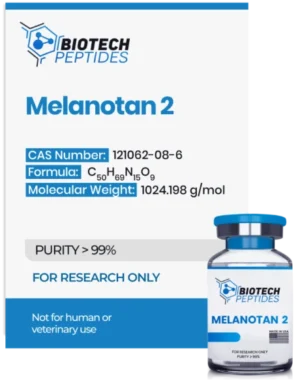
Melanotan 2 (2mg & 10mg)
Melanotan 2 (MT-2) is a synthetic analog of the alpha-melanocyte-stimulating hormone (alpha-MSH). A study conducted at the University of Arizona observed the involvement of alpha-MSH in skin pigmentation in rodents.[1] This finding then led to the development of MT-2 in the 1980s by a team of researchers at the university. It has been examined frequently in laboratory settings to determine its potential in melanin production and various ancillary impacts on the brain.
Price range: $16.00 through $47.00Melanotan 2 (2mg & 10mg)
Price range: $16.00 through $47.00 Select options This product has multiple variants. The options may be chosen on the product page -
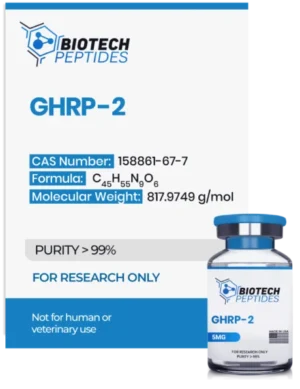
GHRP-2 (5mg)
Specifications
Other Known Titles: Pralmorelin
Molecular Formula: C45H55N9O6
Molecular Weight: 817.9 g/mol
Sequence: H-D-Ala-D-2-Nal-Ala-Trp-D-Phe-Lys-NH2
$20.00 -
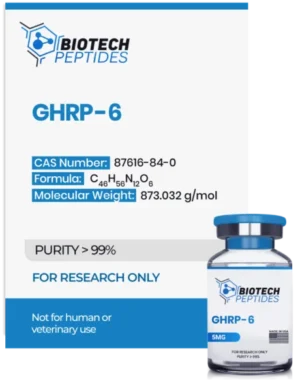
GHRP-6 (5mg)
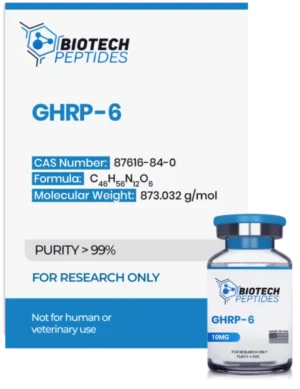
Specifications
Molecular Formula: C46H56N12O6
Molecular Weight: 873.032 g/mol
Sequence: His-D-Trp-Ala-Trp-D-Phe-Lys
$21.00 -
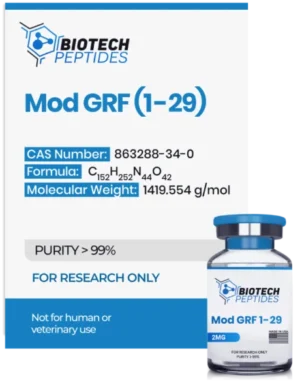
Mod GRF 1-29 (CJC-1295 NO DAC) (2mg)
Modified GRF (1-29), or Mod GRF (1-29), is a synthetic peptide analog of growth hormone-releasing hormone (GHRH). It was first developed in the 1980s when studies indicated that the first 29 amino acids of GHRH may possess all of the biological roles associated with the full-length 44 residue protein.[1] The initially designed peptide, known as GRF (1-29), is the shortest segment of GHRH, and appears to possess all the properties of the full-length hormone. A truncated synthetic form of GHRH known as Sermorelin, or GRF 1-29, also has 29 amino acids. Modified GRF (1-29) undergoes alteration to include four substituted amino groups in its chain.[2] The intention behind these amino modifications is to protect the peptide from both oxidation and degradation during manufacture. The modification also appears to increase the binding affinity to GHRH receptors. Modified GRF (1-29) is also known as Mod GRF, or Tetra-substituted GRF (1-29). The latter name clarifies that the modified peptide differs from GRF (1-29) as a result of changes in four of its amino acids. Modified GRF (1-29) is structurally identical to CJC-1295 without DAC.
$22.00 -
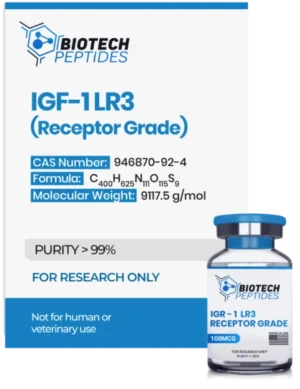
Receptor Grade IGF-1 LR3 (100mcg)
Specifications
Molecular Formula: C400H625N111O115S9
Molecular Weight: 9117.5 g/mol
Sequence: MFPAMPLSSL FVNGPRTLCG AELVDALQFV CGDRGFYFNK PTGYGSSSRR APQTGIVDEC CFRSCDLRRL EMYCAPLKPA KSA
$27.00 -
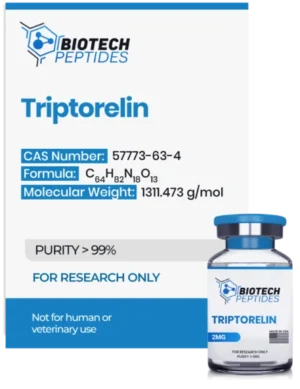
Triptorelin (GnRH) (2mg)
Triptorelin is a synthetic analog of gonadotropin-releasing hormone (GnRH), potentially mimicking the structure and function of the natural hormone. It may bind to GnRH receptors, initially stimulating the hypothalamic-pituitary-gonadal (HPG) axis, leading to a temporary surge in luteinizing hormone (LH) and follicle-stimulating hormone (FSH) levels. In turn, LH and FSH are thought to stimulate endocrine cells, like testicular cells that produce testosterone (T). However, with prolonged exposure, Triptorelin appears to desensitize the GnRH receptors, resulting in suppressed production of LH and FSH, thereby apparently reducing testosterone and estrogen levels. This potential mechanism has been extensively researched in models of androgen deprivation, exploring its potential in various contexts such as prostate cancer cells and receptor-positive breast cancer cells.
$36.00 -
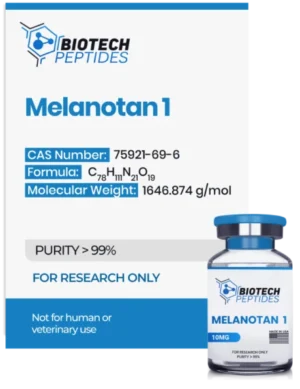
Melanotan 1 (10mg)
Melanotan 1 (MT-1) is a synthetic equivalent of alpha-melanocyte-stimulating hormone (alpha-MSH). The peptide has been exhaustively researched through observation of research models displaying signs of erythropoietic protoporphyria to reduce potential phototoxicity or UV-related damage.[1] It has been suggested that the peptide may have the potential to influence diverse physiological processes like feeding patterns, central nervous system operations, blood pressure, and more.
$38.00 -
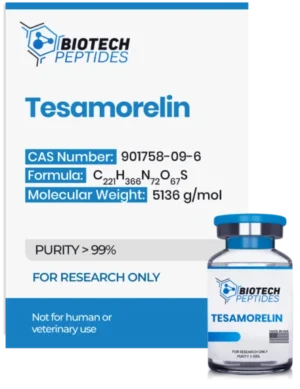
Tesamorelin (5mg & 10mg)
Tesamorelin is a chemically altered growth hormone-releasing hormone (GHRH) analog, that similar to the original is made of 44 amino acids. This peptide is a trans-3-hexanoic acid version of natural GHRH. The trans-3-hexanoic acid group is added to the N-terminus, while the C-terminus is amidated and acetylated. Tesamorelin appears to mediate the positive influence of GHRH and other GHRH analogs such as GRF (1-29), CJC-1295, and Sermorelin. The trans-3-hexanoic acid modification may increase its stability and half-life. Both Tesamorelin and CJC-1295 appear to maintain the physiological activity of GHRH, without disrupting the physiological rhythm of GH release.
Price range: $38.00 through $73.00Tesamorelin (5mg & 10mg)
Price range: $38.00 through $73.00 Select options This product has multiple variants. The options may be chosen on the product page -
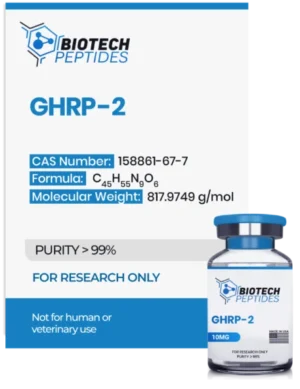
GHRP-2 (10mg)
Specifications
Other Known Titles: Thymosin Beta 4
Molecular Formula: C45H55N9O6
Molecular Weight: 817.9 g/mol
Sequence: H-D-Ala-D-2-Nal-Ala-Trp-D-Phe-Lys-NH2
$39.00 -
-
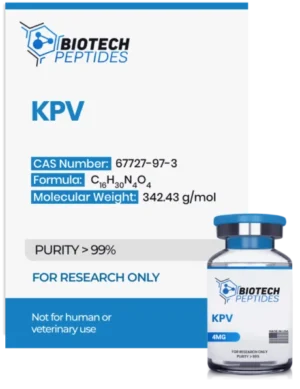
KPV (4mg)
KPV is the C-terminal peptide stretch of alpha-melanocyte-stimulating hormone (alpha-MSH). The peptide consists of the last three amino acids of the alpha-MSH hormone. It has been explored for its potential anti-inflammatory properties at the cellular level. Comprising the amino acids L-Lys-L-Pro-L-Val, KPV represents the minimal sequence that may mitigate inflammation in experimental models. However, the precise mechanisms of its action still need to be further studied in order to be more fully understood.
This peptide’s various mechanisms may potentially differentiate from that of alpha-MSH, which researchers believe interacts with the melanocortin-1 receptors by theoretically activating the cAMP pathway. Instead, studies suggest a rapid and acute increase in intracellular calcium when KPV is introduced alongside N6-(L-2-phenyl isopropyl) adenosine (PIA), an adenosine agonist that inhibits the cAMP pathway.
Further data-gathering investigations using cells transfected with melanocortin-1 receptors have indicated that KPV may, in theory, elevate intracellular calcium levels. This may imply an additional type of interaction with this receptor. This calcium signaling is thought to contribute to the inhibition of the activation of nuclear factor kappa-light-chain-enhancer of activated B cells (NF-κB), a transcription factor involved in inflammatory responses. By potentially inhibiting NF-κB activation, KPV might modulate inflammatory processes within cells.
$39.00 -
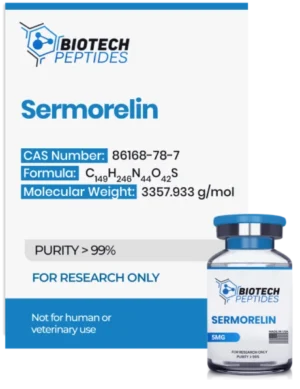
Sermorelin (5mg)
Sermorelin is among the growth hormone-releasing hormone (GHRH) analogs. It is classified as a GHRH as researchers have suggested that the peptide acts to induce the endogenous production and release of growth hormone (hGH). Growth hormone has been associated with numerous physiological activities, making Sermorelin and other GHRH analogs, potentially relevant in growth hormone-related research. Examples of studies employing GHRH analogs include research in the context of tissue scarring following cardiac dysfunction, as well as those examining bone density, renal function, dementia and seizure activity.
$43.00 -
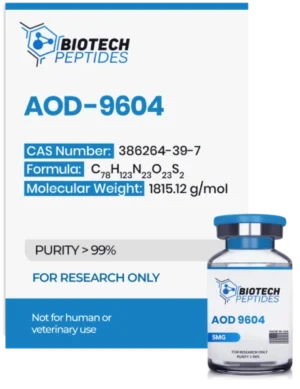
AOD 9604 (5mg)
Specifications
Other Known Titles: AOD-9604
Molecular Formula: C78H123N23O23S2
Molecular Weight: 1815.1 g/mol
Sequence: Tyr-Leu-Arg-Ile-Val-Gln-Cys-Arg-Ser-Val-Glu-Gly-Ser-Cys-Gly-Phe
$44.00 -
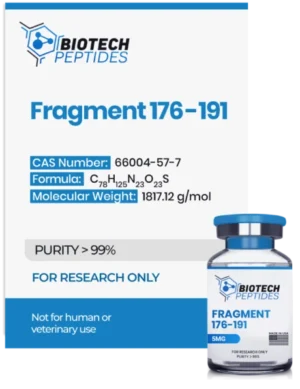
Fragment 176-191 (5mg)
Specifications
Molecular Formula: C78H125N23O23S2
Molecular Weight: 1817.1 g/mol
Sequence: Tyr-Leu-Arg-Ile-Val-Gin-Cys-Arg-Ser-Val-Glu-Gly-Ser-Cys-Gly-Phe
Other Known Titles: Frag 176-191
$44.00 -
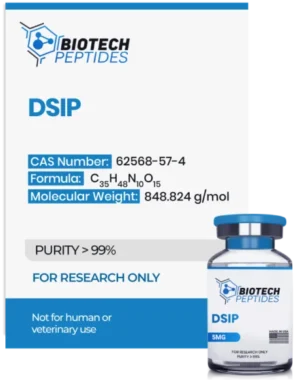
DSIP (5mg)
Specifications
Other Known Titles:Delta Sleep-Inducing Peptide
Molecular Formula: C35H48N10O15
Molecular Weight: 848.82 g/mol
Sequence: Trp-Ala-Gly-Gly-Asp-Ala-Ser-Gly-Glu
$44.00