support@biotechpeptides.ca
-
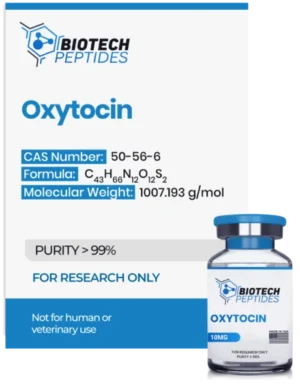
Oxytocin (10mg)
Oxytocin is a small peptide comprising only nine amino acids, naturally produced in the hypothalamus and secreted by the posterior pituitary gland cells. It has also been isolated from placenta, ovaries, testes, adrenal glands, thymus, retina, and pancreas tissues. The active hormone is obtained by proteolytic cleavage of a larger precursor protein. It is no longer considered merely a neurohypophyseal hormone as its actions are considered to be far-reaching and include interaction with additional peptides. Oxytocin appears to be a protein with two independent natural functions. First, it appears to act as a neuropeptide produced by the hypothalamus to regulate bonding, reproduction, and birth. Oxytocin appears to be bloodborne and secreted by the placenta of pregnant animals to influence birth, milk production, and bonding with their young. Small amounts of the protein produced from testes may promote mating behavior and pair bonding.
$45.00 -
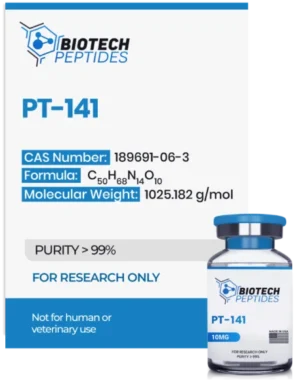
PT-141 (Bremelanotide) (10mg)
PT-141, also known as Bremelanotide, was derived from a synthetic melanocortin analog known as Melanotan 2 (MT-2). A melanocortin analog, such as PT-141 and MT-2, is considered to be any synthetic compound designed to mimic or influence the functions of natural melanocortin peptides. These peptides, such as the alpha-melanocyte stimulating hormone (α-MSH), may be involved in a range of physiological processes including appetite regulation, energy homeostasis, immune responses, and skin cell pigmentation. PT-141 is a melanocortin analog that was developed to interact with Melanocortin-4 Receptor (MC-4R). It has been studied for a variety of potential characteristics and bioactivities through its interaction with this receptor. Apart from MC-4R, there are other melanocortin receptors like MC-1R, MC-2R, MC-3R, and MC-5R, each associated with different potential functions. For instance, MC-1R may be primarily involved in skin cell and hair follicle pigmentation, MC-2R appears to play a crucial role in the adrenal axis and stress response, MC-3R is implicated in the regulation of energy homeostasis, and MC-5R has been linked to exocrine function and thus impacts processes such as sweating and sebum production.
$45.00 -
-
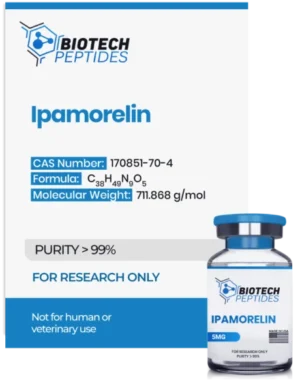
Ipamorelin (5mg)
Ipamorelin is a small pentapeptide that binds to the receptor of ghrelin/growth hormone secretagogue (GHS), and is speculated to trigger the release of growth hormone via pituitary cells. Research has suggested the peptide to be selective in its mode of action.[1] Ipamorelin, researchers report, does not appear to induce non-specific release of hormones like prolactin, thyroid-stimulating hormone, ACTH, luteinizing hormone, follicle-stimulating hormone, or cortisol. The high specificity of the peptide makes it an ideal model for the study of selectivity in receptor binding. It appears to function through interaction with cognate receptors on the target cell surface and mediates a cellular response. Ipamorelin may induce secretions from the pituitary gland, promoting growth in animal study models.[2] In addition, it may not only trigger the expression of insulin-like growth factor-1(IGF-1) but may also inhibit the secretion of somatostatin. IGF-1 is considered to be the main anabolic mediator of growth hormone.
$46.00 -
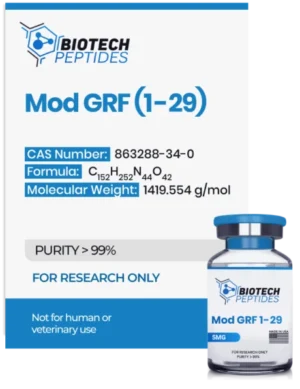
Mod GRF 1-29 (CJC-1295 NO DAC) (5mg)
Modified GRF (1-29), or Mod GRF (1-29), is a synthetic peptide that is a modified fragment of the endogenously occurring growth hormone-releasing hormone (GHRH). It was first developed in the 1980s when studies indicated that the first 29 amino acids of GHRH may possess all of the biological potential associated with the full-length 44 GHRH molecule.[1]
This discovery led to the development of a truncated version called GRF (1-29), also referred to as Sermorelin by researchers. Mod GRF (1-29) introduces specific modifications to support the peptide’s stability and efficacy. Four amino acids in the sequence are substituted at positions 2, 8, 15, and 27.[2] Here is what some researchers believe about these modifications:
– Position 2: The amino acid alanine is replaced with its mirror image, D-alanine. This substitution aims to increase resistance to enzymatic degradation, thereby improving the peptide’s stability.
– Position 8: Asparagine is substituted with lysine, an amino acid with a positively charged side chain. This change may support the peptide’s binding affinity to GHRH receptors, potentially increasing its biological activity.
– Position 15: Histidine is replaced with D-phenylalanine, another D-amino acid. This modification is intended to protect the peptide from further enzymatic breakdown.
– Position 27: Cysteine is substituted with N-methylglycine, also referred to as sarcosine. This alteration may extend the peptide’s half-life by mitigating enzymatic cleavage.These modifications collectively aim to produce a peptide with increased stability, a longer half-life, and better-supported interaction with GHRH receptors compared to the original GRF (1-29). Modified GRF (1-29) is structurally identical to CJC-1295 without DAC. The DAC in CJC-1295 serves to modify its pharmacokinetic properties.
$46.00 -
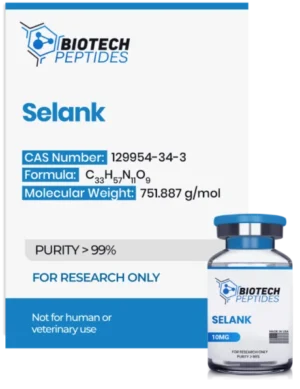
Selank (10mg)
Selank is a small peptide studied for its potential nootropic and behavior-modifying functions in experimental models. It is a synthetic analog of naturally occurring Tuftsin. This immunomodulatory peptide is a short fragment from the immunoglobulin G (IgG), a natural tetrapeptide involved in certain functions that may regulate the immune system. Selank is also posited to possess additional potential for regulating immune cells, IL-6, a wide range of neurotransmitter systems, and brain-derived neurotrophic factor (BDNF).
Selank differs in structure from the endogenous Tuftsin by an additional three amino acids in its chain, which have been supposed to enhance the metabolic stability and half-life of the synthetic peptide. Specifically, that is the Pro-Gly-Pro segment at the C-terminus of Selank, which might enhance its ability to move through various models, including the blood-brain barrier (BBB). The BBB is a highly selective and semi-permeable barrier that separates circulating blood from the tissues and extracellular fluid of the central nervous system, playing a vital role in regulating substance passage.
The inclusion of Pro-Gly-Pro may possibly increase BBB permeability by affecting the peptide’s hydrophilicity or lipophilicity, which may enhance its affinity for the BBB’s lipid-rich environment. Furthermore, the Pro-Gly-Pro sequence might interact with specific transport mechanisms or receptors at the BBB, possibly initiating facilitated transport or receptor-mediated endocytosis. These processes may enable Selank to circumvent the tight junctions that are said to typically restrict larger molecules.
$46.00 -
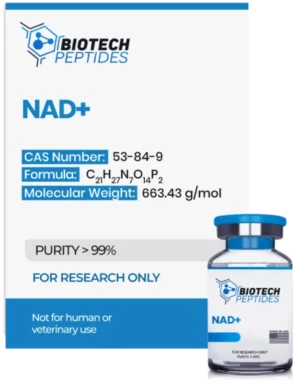
NAD+ (100mg & 500mg)
Nicotinamide Adenine Dinucleotide (NAD+) is an oxidized form of NADH (Nicotinamide Adenine Dinucleotide Hydroxide). NAD+ is a component of the Electron Transport Chain (ETC), which researchers have suggested to act in carrying electrons and thus energy within cells. The peptide has also been posited to potentially act as a mediator for various physiological processes, such as post-translational modification of the proteins and activation/deactivation of some enzymes. It is believed to be a critical component in maintaining cell-to-cell communication.
Price range: $46.00 through $179.00NAD+ (100mg & 500mg)
Price range: $46.00 through $179.00 Select options This product has multiple variants. The options may be chosen on the product page -
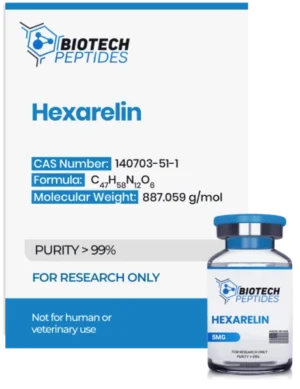
Hexarelin (5mg)
Specifications
Molecular Formula: C47H58N12O6
Molecular Weight: 887.05 g/mol
Sequence: His-2-Me-D-Trp-Ala-Trp-D-Phe-Lys-NH2
$49.00 -
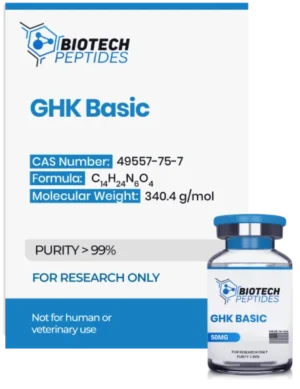
GHK Basic (50mg)
GHK is a copper peptide that occurs naturally in a copper complex of the tripeptide glycyl-L-histidyl-L-lysine. It has two variants — GHK with or without Cu. GHK appears to have a strong affinity for copper (II), and it is synthesized naturally from plasma, although it has been isolated in other areas. In cases of injury, GHK may be released from tissue cells. The copper peptide appears to affect genes that control injury and stress responses. Its functions appear to include the following: tissue remodeling, anti-inflammatory response, pain perception inhibition, nootropic action anti-cancer action, blood vessel growth, and nerve outgrowth. A decrease in the regenerative capacity of an organism may be traced to a decline in GHK-level. Its potential functions extend to infection control, follicle growth, collagen and elastin production increases, tissue repair, and glycosaminoglycan synthesis. Endogenous GHK production is considered to decline over time.
$51.00 -
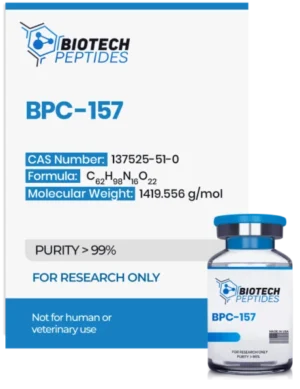
BPC-157 (5mg & 10mg)
Specifications
Molecular Formula: C62H98N16O22
Molecular Weight: 1419.556 g/mol
Sequence: L-Valine,glycyl-L-alpha-glutamyl-L-prolyl-L-prolyl-Lprolylglycyl-L-lysyl-L-prolyl-L-alanyl-L-alpha-aspartyl-L-alpha-aspartyl-L-alanylglycyl-L-leucyl-;glycyl-L-alpha-glutamyl-L-prolyl-L-prolyl-L-prolylglycyllysyl-L-prolyl-L-alanyl-L- alpha-aspartylL-alpha-aspartyl-L-alanylglycyl-L-leucyl-L-valine
Price range: $52.00 through $92.00BPC-157 (5mg & 10mg)
Price range: $52.00 through $92.00 Select options This product has multiple variants. The options may be chosen on the product page -
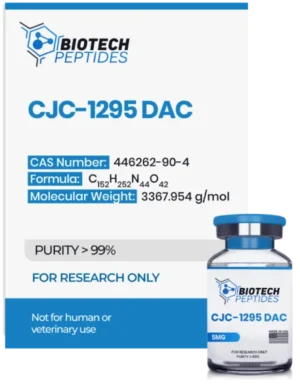
CJC-1295 DAC (5mg)
Specifications
Other Known Titles: CJC-1295 with DAC
Molecular Formula: C152H252N44O42
Molecular Weight: 3367.954 g/mol
Sequence: H-Tyr-D-Ala-Asp-Ala-Ile-Phe-Thr-Gln-Ser-Tyr-Arg-Lys-Val-Leu-Ala-Gln-Leu-Ser-Ala-Arg-Lys-Leu-Leu-Gln-Asp-Ile-Leu-Ser-Arg-Lys(Mal)-NH2
$52.00 -
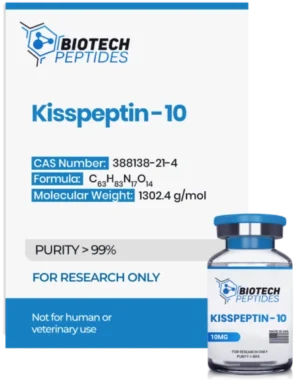
Kisspeptin-10 (10mg)
Kisspeptin-10 is a peptide fragment derived from the full-length Kisspeptin (also referred to as Kisspeptin-54 or Metastin). Specifically, Kisspeptin-10 is a fragment containing the 45-54 sequence from the larger parent molecule. Research into this peptide has suggested that the compound may act as a mediator of endocrine signaling between various endocrine cells.
Originating from the KISS1 gene, which is thought to play a critical role in reproductive cell signaling and physiology, Kisspeptin-10 is particularly interesting to researchers for its potential to influence the secretion of gonadotropin-releasing hormone (GnRH). This, in turn, may affect the release of other reproductive hormones from cells with receptors for GnRH. In addition, researchers posit that the compound may potentially impact the development and regulation of blood vessels and renal function, and some studies have suggested it may mitigate cancer cell proliferation and metastasis.
$52.00 -
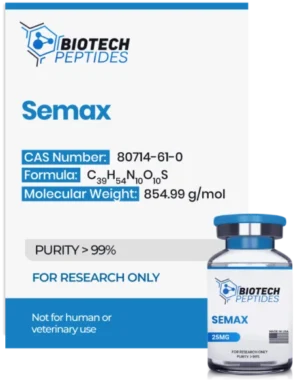
Semax (25mg)
Semax is a synthetic analog of adrenocorticotropic hormone (ACTH) comprising the amino acids 4 through 10 of ACTH. Semax has primarily been implicated in research on cognitive impairment and stroke. The peptide has also been studied closely within the context of dementia and certain inflammations of the optic nerve. Researchers posit that the peptide may exert neurotrophic action, suggesting that the peptide may act to increase the production of brain-derived neurotrophic factor (BDNF) in the central nervous system, with potential consequences in serotonin and dopamine release. Some researchers also suggest that Semax may interact with serotonin and enkephalin levels in the central nervous system.
$53.00 -
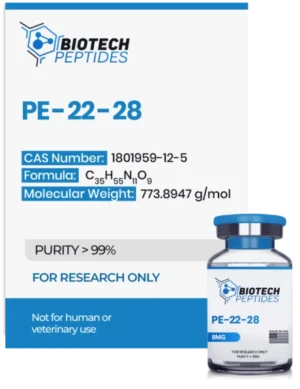
PE-22-28 (8mg)
PE-22-28 is a synthetic variant of the naturally occurring peptide Spadin. Spadin is a secreted peptide obtained from Sortilin. It appears to act as an antagonist of the TREK-1 (TWIK-related-potassium channel) receptor, a two-pore potassium channel identified as a potential target in the context of depression research and as a possible neurogenic regulator. Studies in mice have suggested that TREK-1 receptor deletion may make them resistant to depressive behavior and corresponding chemical imbalances in the brain.[1] PE-22-28 represents a shorter seven amino acid synthetic Spadin analog with potentially higher efficacy and stability. Research in animal models is ongoing.
$55.00 -

Retatrutide (6mg)
AMP-3P 6mg is a ≥ 99 % pure triple-agonist peptide supplied as a lyophilized
powder.$55.00