support@biotechpeptides.ca
-
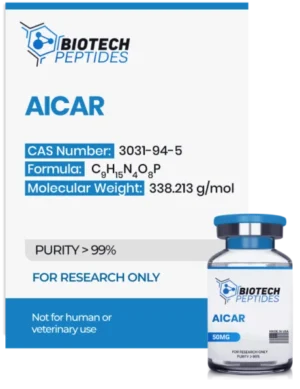
AICAR (50mg)
AICAR or 5-Aminoimidazole-4-carboxamide ribonucleotide, is a synthetic adenosine monophosphate analog. It was developed to stimulate the AMP-dependent protein kinase (AMPK) activity.[1][2] It is currently being investigated as a protective agent against ischemic damage in the cardiac myocytes during cardiac injury. The AMP-activated protein kinase is an enzyme and a protein that may play a regulatory role in several metabolic pathways. Its expression has been observed in several tissues, including the skeletal muscles, liver, and brain. In all these tissues, it is considered to exert a potential net effect on lipogenesis and may inhibit cholesterol synthesis and ketogenesis. It may also modulate insulin secretion and skeletal muscle fatty acid oxidation with glucose uptake. Several energy deficit states may trigger the release of AMPK, like hypoxia or hypoglycemia.
$56.00 -
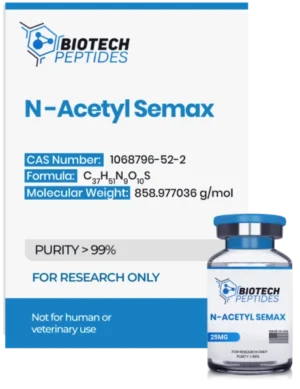
N-Acetyl Semax (25mg)
N-Acetyl Semax is posited to be an acetylated form of the Semax peptide. The peptide consists of a 4 amino acid fragment (Met-Glu-His-Phe) from the chain of melanocortin hormones. These include the adrenocorticotropic hormone (ACTH) and a Pro-Gly-Pro fragment. The integration of Pro-Gly-Pro (PGP) into N-Acetyl Semax may potentially enhance the permeability of the peptide through the blood-brain barrier (BBB). This enhancement might occur by increasing the peptide’s lipophilicity, thereby potentially improving passive diffusion or uptake via lipid raft-mediated endocytosis.
This process may hypothetically allow the peptide to bypass the BBB’s tight junctions, which researchers claim are usually highly restrictive. Adding PGP at the C-terminus might also modify the peptide’s interactions with specific BBB transporters or receptors, possibly facilitating receptor-mediated transcytosis. Receptor-mediated transcytosis is a process where substances are transported across cells via specific receptors, and alterations at the C-terminus might influence this pathway.
Researchers have noted that the acetylation of the peptide into N-Acetyl Semax appears to reduce the affinity of other ions, such as Cu++, to its N-terminus.[1] Acetylation may contribute to an increase in the peptide’s resistance to enzymatic degradation, potentially leading to an extended half-life observed in experimental models. Increased resistance to degradation might mean that the peptide potentially remains active for a longer period, which may enhance its stability.
$57.00 -
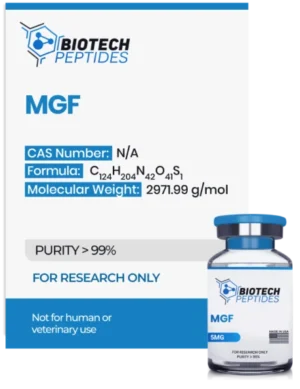
MGF (Mechano-Growth Factor) (5mg)
Mechano-Growth Factor (MGF) is an alternative name for the Insulin-like Growth Factor-1Eb (IGF-1Eb), an isoform of IGF-1. It has been studied for its potential in remodeling muscles, cellular survival, and cellular proliferation.[1] New studies on this specific isoform highlight its potential for activating satellite cells in skeletal muscle, suggesting that this particular isoform may also activate satellite cells in skeletal muscle, protect neurons, and help overcome muscle mass loss.[2] The principal function of MGF is its possible efficacy in reparating severe muscle wear and tear. Further, its concentration appears to correspond with skeletal muscle growth and differentiation found in rodent models.
$59.00 -
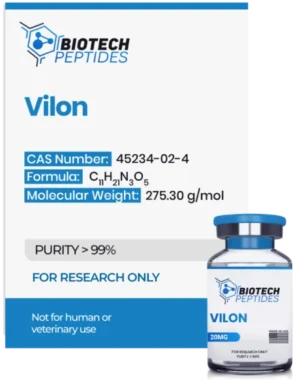
Vilon (20mg)
Vilon (or Lyslglutamic Acid) is a peptide with apparent immunomodulatory and anti-aging bioregulation potential. It is a short peptide with just two amino acids in length. Scientific research suggests it may potentially act to regulate the vascular system and encourage hemostasis. Its functions may be more widespread, with studies indicating its possible influence in reducing the prevalence and growth of spontaneous tumors. Advocate researchers like Dr. Vladimir Anisimov believe that the peptide may become more widespread in contemporary research within the context of geroprotection.
$61.00 -
B7-33 (6mg)
B7-33 is a soluble synthetic single-chain peptide obtained from the larger, naturally occurring protein H2-relaxin (Relaxin), which is considered to induce pleiotropic actions impacting the musculoskeletal system, cardiovascular system, and reproduction.[1] B7-33 appears to retain the anti-fibrotic properties of Relaxin without enhancing cAMP production, it may also stimulate ERK1/2 phosphorylation and promote matrix metalloproteinase 2 (MMP2) expression and the degradation of extracellular collagen. The Relaxin family of peptides has four endogenous receptors divided into two pairs (RXFP1/2 and RXFP3/4).[2] The Relaxin receptors appear to be stimulated by cAMP, orexin, corticotropin-releasing factor (CRF), several insulin-like peptides, and GLP-1. The agonists have been observed to exhibit anti-inflammatory, antioxidant, and tissue-repairing characteristics.
$62.00 -
Cardiogen (20mg)
Cardiogen is a cardiovascular bioregulator peptide complex. Results obtained from research studies suggest that Cardiogen’s primary functions may be correlated to fibroblast action, cells considered responsible for scar formation and tissue repair. The peptide has a sequence of H-Ala-Glu-Asp-Arg-OH (AEDR).[1] Research posits that the synthetic tetrapeptide Cardiogen may potentially stimulate cell proliferation in myocardial tissue. Additionally, it appears that Cardiogen may possibly inhibit myocardial cell apoptosis (cell death), hypothetically through the reduction of p53 protein expression.
$62.00 -
Livagen (20mg)
Livagen is a short peptide bioregulator, similar in structure to Epitalon. It is a tetrapeptide made of the amino acids Lys-Glu-Asp-Ala (KEDA) and is classified amongst Khavinson’s peptides. As a bioregulator, the peptide may interact with genetic material in different cells and consequently unpack and “unlock” various cellular genes. Livagen’s impacts appear to be exhibited directly on the lymphocytes (cells of the immune system), liver, and gastrointestinal tract (GIT). Its direct functions may be widespread, as suggested through research studies on DNA and gene expression patterns. The potential of the Livagen peptide to activate genes enclosed in the GIT and immune system may reflect possible age-mitigating characteristics exerted on cells.
$62.00 -
Chonluten (T-34) (20mg)
Chonluten is also known as Tripeptide T-34 or EDG, due to its sequence (Glu-Asp-Gly). It is a cytogenetic complex consisting of short peptides that are suggested to normalize the mucous membrane cells of the lungs and the bronchial tube. It is a gene regulator associated with inflammation and antioxidant activity, and is considered to be involved in proliferation responses.[1] It appears to function in animal test models as an anti-inflammatory in the lungs, normalizing the mucosal functions of the lungs in conditions like asthma and chronic obstructive pulmonary disease (COPD).
$62.00 -
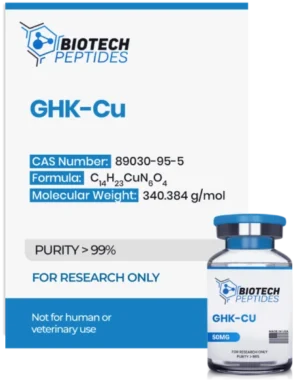
GHK-CU (Copper) (50mg)
Specifications
Molecular Formula: C14H23CuN6O4
Molecular Weight: 340.38 g/mol
Sequence: Gly-His-LysCu.xHAc
$64.00 -
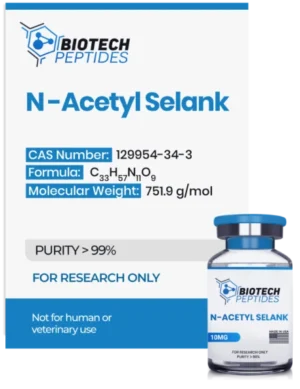
N-Acetyl Selank (10mg)
N-Acetyl Selank is an acetylated form of the Selank peptide. The acetylation of the peptide into N-Acetyl Selank appears to improve its stability. Selank is a synthetic analogue of the natural tetrapeptide Tuftsin. Tuftsin is an immunomodulatory peptide, and N-Acetyl Selank appears to share many of its potential functions. In addition, N-acetyl Selank also appears to exhibit an impact on neurotransmitters, brain signaling, and neuroplasticity.
$65.00 -
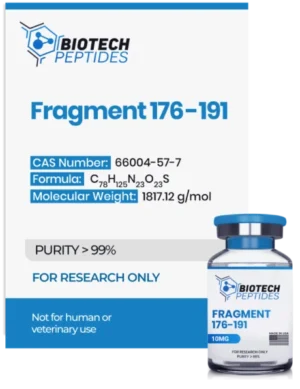
Fragment 176-191 (10mg)
Specifications
Other Known Titles: Frag 176-191
Molecular Formula: C78H125N23O23S2
Molecular Weight: 1817.1 g/mol
Sequence: Tyr-Leu-Arg-Ile-Val-Gin-Cys-Arg-Ser-Val-Glu-Gly-Ser-Cys-Gly-Phe
$67.00 -
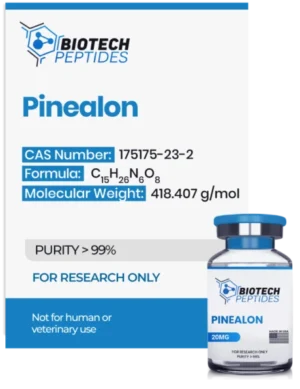
Pinealon (20mg)
Pinealon (also referred to as EDR) is a short peptide comprising only three amino acids (Glu-Asp-Arg). Additionally, it is classified as one of Khavinson’s peptides. EDR is generally extracted from a crude polypeptide extract called Cortexin. Pinealon is considered to be a peptide bioregulator, and it appears to interact directly with DNA. It may contribute to the alteration of gene expression levels. It may potentially exhibit behavior modification and may protect various cell types, including neurons, against hypoxia. Pinealon has been studied for its potential to impact the pineal gland to address issues with metabolism, circadian rhythm disorders, and certain cognitive functions.
$68.00 -
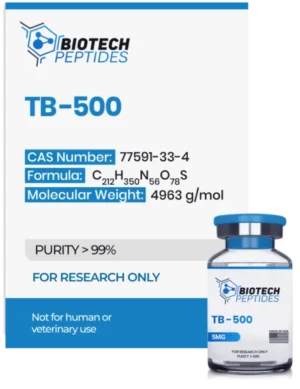
TB-500 (Thymosin Beta-4) (5mg)
TB-500, or Thymosin Beta-4, is a synthetic analog of the endogenous Thymosin beta 4 protein, which is considered ubiquitously present in cells. The peptide belongs to a widespread family of 16 related molecules considered to exhibit a high degree of sequence conservation and localization in the majority of tissues and circulating cells.
Thymosin Beta-4 is speculated to encompass a unique peptide sequence, LKKTETQ, found between the 16th and 24th amino acids. This sequence is thought to assist in actin binding potentially. Actins are proteins believed to be vital to the cell’s cytoskeleton. They appear to maintain the cell’s structural framework and are considered by experts to be crucial for primary cellular activities, such as movement.
It is hypothesized that Thymosin Beta-4 associates with actin by attaching to globular actin (G-actin), the monomeric form of actin, before it forms filamentous actin (F-actin). This suggested interaction between Thymosin Beta-4 and G-actin might impede the polymerization process, a mechanism known as actin sequestration. This interference might potentially increase the concentration of G-actin.
The assumed inhibition of F-actin polymerization by Thymosin Beta-4 might result in alterations to the cellular cytoskeleton’s structure. These changes may impact the cell’s ability to move and undergo shape transformations.[1] TB-500 was developed with the intention of sequestering and blocking actin polymerization in eukaryotic cells and influencing cell motility and transformation in experimental settings.
$70.00 -
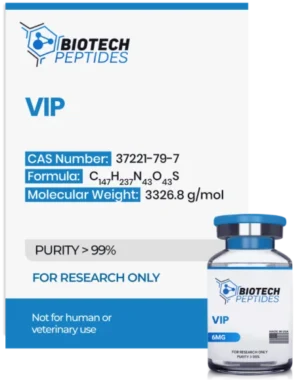
VIP (6mg)
Vasoactive intestinal peptide (VIP, vasoactive intestinal polypeptide, PHM27) is a short peptide hormone endogenously produced in the gastrointestinal tract, pancreas, and brain of most vertebrate animals. Researchers have suggested that the peptide may exhibit potential to influence inflammation, particularly in the cases of neurodegenerative disease, pulmonary fibrosis, inflammatory bowel disease, and cardiac fibrosis. VIP has been suggested to act as an immune system regulator and has been classified by scientists as an anti-inflammatory peptide. It is of active scientific interest for its proposed ability to support cognitive function in the setting of neurodegenerative disease. VIP has been hypothesized to bind to class II G protein-coupled receptors.
$71.00 -
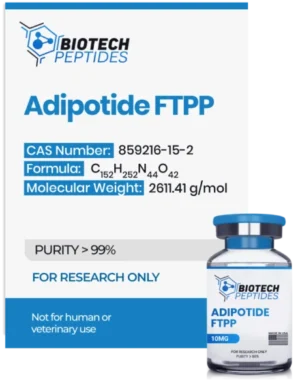
Adipotide FTPP (10mg)
Specifications
Other Known Titles: Adipotide
Molecular Formula: C152H252N44O42
Molecular Weight: 2611.41 g/mol
Sequence: Cys-Lys-Gly-Gly-Arg-Ala-Lys-Asp-Cys—Gly-Gly–(Lys-Leu-Ala-Lys-Leu-Ala-Lys)2
$77.00