support@biotechpeptides.ca
-
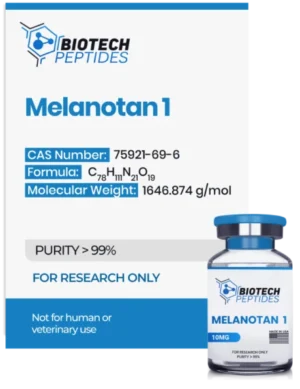
Melanotan 1 (10mg)
Melanotan 1 (MT-1) is a synthetic equivalent of alpha-melanocyte-stimulating hormone (alpha-MSH). The peptide has been exhaustively researched through observation of research models displaying signs of erythropoietic protoporphyria to reduce potential phototoxicity or UV-related damage.[1] It has been suggested that the peptide may have the potential to influence diverse physiological processes like feeding patterns, central nervous system operations, blood pressure, and more.
$38.00 -
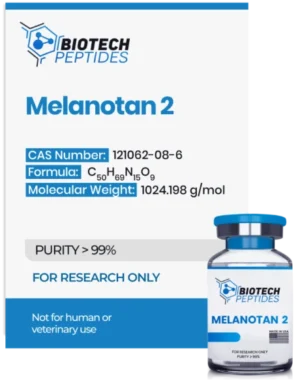
Melanotan 2 (2mg & 10mg)
Melanotan 2 (MT-2) is a synthetic analog of the alpha-melanocyte-stimulating hormone (alpha-MSH). A study conducted at the University of Arizona observed the involvement of alpha-MSH in skin pigmentation in rodents.[1] This finding then led to the development of MT-2 in the 1980s by a team of researchers at the university. It has been examined frequently in laboratory settings to determine its potential in melanin production and various ancillary impacts on the brain.
Price range: $16.00 through $47.00Melanotan 2 (2mg & 10mg)
Price range: $16.00 through $47.00 Select options This product has multiple variants. The options may be chosen on the product page -
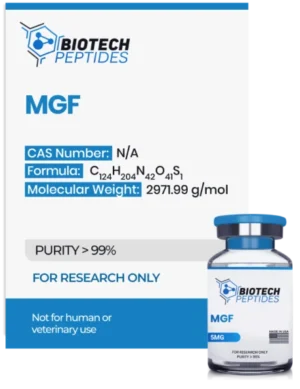
MGF (Mechano-Growth Factor) (5mg)
Mechano-Growth Factor (MGF) is an alternative name for the Insulin-like Growth Factor-1Eb (IGF-1Eb), an isoform of IGF-1. It has been studied for its potential in remodeling muscles, cellular survival, and cellular proliferation.[1] New studies on this specific isoform highlight its potential for activating satellite cells in skeletal muscle, suggesting that this particular isoform may also activate satellite cells in skeletal muscle, protect neurons, and help overcome muscle mass loss.[2] The principal function of MGF is its possible efficacy in reparating severe muscle wear and tear. Further, its concentration appears to correspond with skeletal muscle growth and differentiation found in rodent models.
$59.00 -
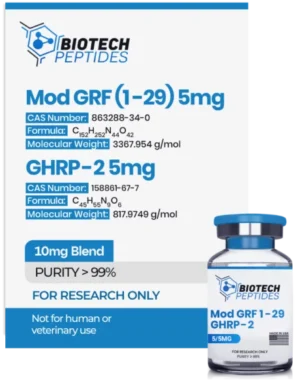
Mod GRF 1-29 & GHRP-2 Blend (10mg)
Modified GRF 1-29 (also abbreviated as Mod GRF 1-29), is a synthetic peptide analog of Growth Hormone Releasing Hormone (GHRH). It is a modified version of the first twenty-nine amino acids of the naturally occurring GHRH. This modification has been suggested to provide better stability and potentially reduce metabolic clearance. More specifically, the modifications may involve the substitution of four specific amino acids within the initial 29 amino acids of Growth Hormone-Releasing Hormone (GHRH). These changes occur at the 2nd, 8th, 15th, and 27th positions and may potentially enhance the peptide’s durability against enzymatic degradation, especially by enzymes such as dipeptidyl peptidase-4 (DPP-4). It is hypothesized that replacing L-alanine with D-alanine at the second position may increase resistance to molecular breakdown. Furthermore, replacing asparagine with glutamine at the eighth position might reduce the likelihood of asparagine reconfiguration and amide hydrolysis. Additionally, substituting glycine with alanine at the 15th position may improve bioactivity. Lastly, the switch from methionine to leucine at the 27th position is thought to help prevent methionine oxidation. It may lead to natural growth hormone production and increased levels of IGF-1 (Insulin-Like Growth Factor-1).
$84.00 -
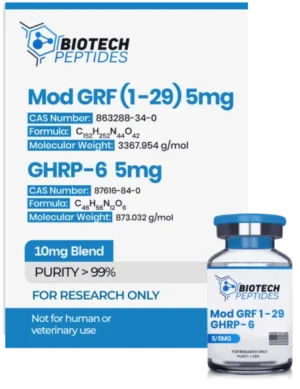
Mod GRF 1-29 & GHRP-6 (10mg)
Modified Growth Hormone Releasing Factor (Mod GRF 1-29) and Growth Hormone Releasing Peptide-6 (GHRP-6) are two peptides that researchers believe may support the secretion of growth hormone (GH) from cells in the anterior pituitary gland. The peptides may offer this support through distinct biological pathways. Mod GRF (1-29) is a synthetic peptide derived from Growth Hormone Releasing Hormone (GHRH), an endogenous hormone consisting of 44 amino acids that stimulates GH release. Some studies have indicated that the initial 29 amino acids of GHRH retain their full biological activity.[1] Modifications to this fragment, resulting in Mod GRF (1-29), are believed to increase its potency and prolong its duration of action, possibly due to better-supported stability against enzymatic degradation.
$86.00 -
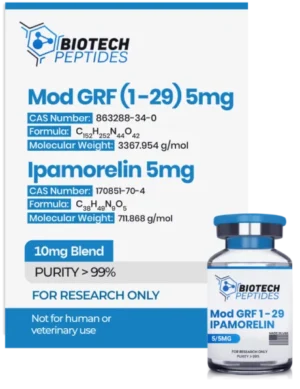
Mod GRF 1-29 & Ipamorelin Blend (10mg)
Modified GRF 1-29 and Ipamorelin are separate peptides, which research indicates may work synergistically to induce potential growth hormone release and growth hormone pulses. This increase may result in several downstream physiological activities associated with increased growth hormone release. Modified GRF 1-29 peptide is an analog of growth hormone-releasing hormone (GHRH).[1] It is also known as tetra-substituted GRF (1-29), and is composed of a sequence thought to be the smallest necessary to interact with GHRH receptors, specifically the first 29 amino acids of GHRH. On the other hand, Ipamorelin is suggested to act via binding to growth hormone secretagogue (GHS) receptors.[2] These receptors are also known as the ghrelin receptors, and Ipamorelin appears to be a highly selective pentapeptide that binds and activates them.
$81.00 -
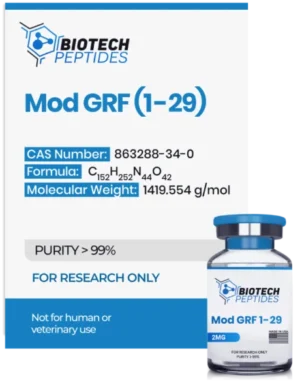
Mod GRF 1-29 (CJC-1295 NO DAC) (2mg)
Modified GRF (1-29), or Mod GRF (1-29), is a synthetic peptide analog of growth hormone-releasing hormone (GHRH). It was first developed in the 1980s when studies indicated that the first 29 amino acids of GHRH may possess all of the biological roles associated with the full-length 44 residue protein.[1] The initially designed peptide, known as GRF (1-29), is the shortest segment of GHRH, and appears to possess all the properties of the full-length hormone. A truncated synthetic form of GHRH known as Sermorelin, or GRF 1-29, also has 29 amino acids. Modified GRF (1-29) undergoes alteration to include four substituted amino groups in its chain.[2] The intention behind these amino modifications is to protect the peptide from both oxidation and degradation during manufacture. The modification also appears to increase the binding affinity to GHRH receptors. Modified GRF (1-29) is also known as Mod GRF, or Tetra-substituted GRF (1-29). The latter name clarifies that the modified peptide differs from GRF (1-29) as a result of changes in four of its amino acids. Modified GRF (1-29) is structurally identical to CJC-1295 without DAC.
$22.00 -
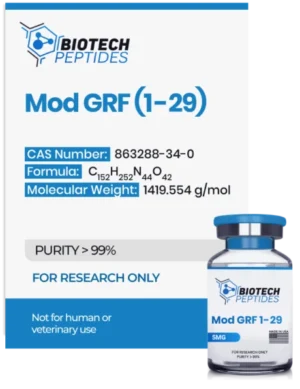
Mod GRF 1-29 (CJC-1295 NO DAC) (5mg)
Modified GRF (1-29), or Mod GRF (1-29), is a synthetic peptide that is a modified fragment of the endogenously occurring growth hormone-releasing hormone (GHRH). It was first developed in the 1980s when studies indicated that the first 29 amino acids of GHRH may possess all of the biological potential associated with the full-length 44 GHRH molecule.[1]
This discovery led to the development of a truncated version called GRF (1-29), also referred to as Sermorelin by researchers. Mod GRF (1-29) introduces specific modifications to support the peptide’s stability and efficacy. Four amino acids in the sequence are substituted at positions 2, 8, 15, and 27.[2] Here is what some researchers believe about these modifications:
– Position 2: The amino acid alanine is replaced with its mirror image, D-alanine. This substitution aims to increase resistance to enzymatic degradation, thereby improving the peptide’s stability.
– Position 8: Asparagine is substituted with lysine, an amino acid with a positively charged side chain. This change may support the peptide’s binding affinity to GHRH receptors, potentially increasing its biological activity.
– Position 15: Histidine is replaced with D-phenylalanine, another D-amino acid. This modification is intended to protect the peptide from further enzymatic breakdown.
– Position 27: Cysteine is substituted with N-methylglycine, also referred to as sarcosine. This alteration may extend the peptide’s half-life by mitigating enzymatic cleavage.These modifications collectively aim to produce a peptide with increased stability, a longer half-life, and better-supported interaction with GHRH receptors compared to the original GRF (1-29). Modified GRF (1-29) is structurally identical to CJC-1295 without DAC. The DAC in CJC-1295 serves to modify its pharmacokinetic properties.
$46.00 -
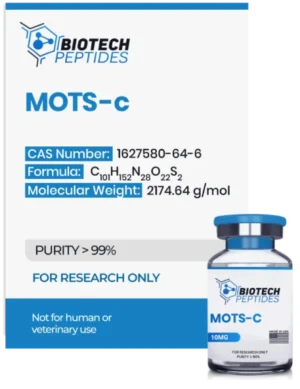
MOTS-c (10mg)
MOTS-c (mitochondrial open-reading-frame of the 12S rRNA-c) is a 16 amino acid peptide classified as a Mitochondrial-Derived Peptide (MDP), aka “mitochondrial hormone” or “mitokine.” Recent research indicates that MOTS-c is a bioactive peptide closely associated with mitochondrial communication and energy regulation. Initially, researchers hypothesized that it might be most active in the mitochondria, however recent studies suggest otherwise, that MOTS-c may operate via the bloodstream, exhibiting a potentially systemic action.
It is important to note that MOTS-c is a newly identified MDP. Its primary roles are under investigation, but studies include MOTS-c peptide’s influence in cell function and longevity, muscle contractile force, metabolic function and weight regulation.
$99.00 -
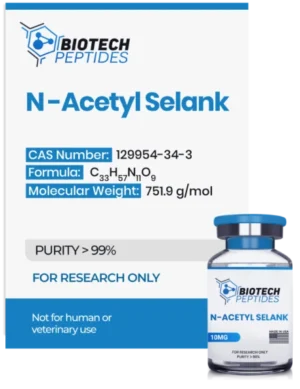
N-Acetyl Selank (10mg)
N-Acetyl Selank is an acetylated form of the Selank peptide. The acetylation of the peptide into N-Acetyl Selank appears to improve its stability. Selank is a synthetic analogue of the natural tetrapeptide Tuftsin. Tuftsin is an immunomodulatory peptide, and N-Acetyl Selank appears to share many of its potential functions. In addition, N-acetyl Selank also appears to exhibit an impact on neurotransmitters, brain signaling, and neuroplasticity.
$65.00 -
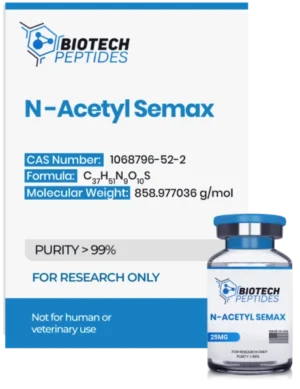
N-Acetyl Semax (25mg)
N-Acetyl Semax is posited to be an acetylated form of the Semax peptide. The peptide consists of a 4 amino acid fragment (Met-Glu-His-Phe) from the chain of melanocortin hormones. These include the adrenocorticotropic hormone (ACTH) and a Pro-Gly-Pro fragment. The integration of Pro-Gly-Pro (PGP) into N-Acetyl Semax may potentially enhance the permeability of the peptide through the blood-brain barrier (BBB). This enhancement might occur by increasing the peptide’s lipophilicity, thereby potentially improving passive diffusion or uptake via lipid raft-mediated endocytosis.
This process may hypothetically allow the peptide to bypass the BBB’s tight junctions, which researchers claim are usually highly restrictive. Adding PGP at the C-terminus might also modify the peptide’s interactions with specific BBB transporters or receptors, possibly facilitating receptor-mediated transcytosis. Receptor-mediated transcytosis is a process where substances are transported across cells via specific receptors, and alterations at the C-terminus might influence this pathway.
Researchers have noted that the acetylation of the peptide into N-Acetyl Semax appears to reduce the affinity of other ions, such as Cu++, to its N-terminus.[1] Acetylation may contribute to an increase in the peptide’s resistance to enzymatic degradation, potentially leading to an extended half-life observed in experimental models. Increased resistance to degradation might mean that the peptide potentially remains active for a longer period, which may enhance its stability.
$57.00 -
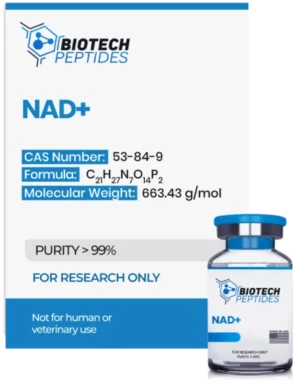
NAD+ (100mg & 500mg)
Nicotinamide Adenine Dinucleotide (NAD+) is an oxidized form of NADH (Nicotinamide Adenine Dinucleotide Hydroxide). NAD+ is a component of the Electron Transport Chain (ETC), which researchers have suggested to act in carrying electrons and thus energy within cells. The peptide has also been posited to potentially act as a mediator for various physiological processes, such as post-translational modification of the proteins and activation/deactivation of some enzymes. It is believed to be a critical component in maintaining cell-to-cell communication.
Price range: $46.00 through $179.00NAD+ (100mg & 500mg)
Price range: $46.00 through $179.00 Select options This product has multiple variants. The options may be chosen on the product page -
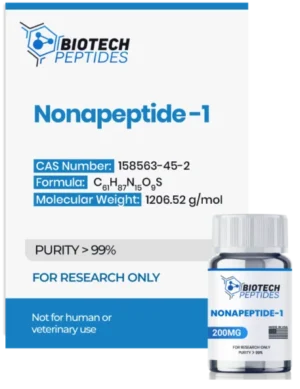
Nonapeptide-1 (200mg)
Nonapeptide-1, also termed Melanostatine-5, is a peptide that may prevent the activation of pigment-producing cells in the skin called melanocytes. It appears to be one of the most potent inhibitors of a receptor found in these pigment-producing cells, called the melanocortin-1 receptor (MC1R). Researchers have explored a peptide library containing 31,360 structurally different compounds, and it appears that the most potent inhibitor identified was Met-Pro-D-Phe-Arg-D-Trp-Phe-Lys-Pro-Val-NH₂, aka Nonapeptide-1.[1] Structural analysis has revealed that specific amino acids, such as D-Trp at position 5 and Phe at position 6, are considered crucial for their antagonistic potential. The presence of D-Phe at position 3 further underscores such potential. Research on animal models suggests that Nonapeptide-1 may inhibit the synthesis of melanin, bringing it to the forefront of research on conditions impacting skin pigmentation, such as melasma. Studies in animal models posit that Nonapeptide-1 may reduce the synthesis of melanin and potentially decrease pigmentation on a considerable scale.
$210.00 -
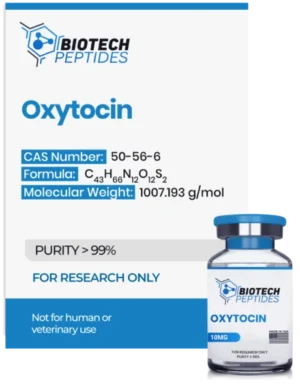
Oxytocin (10mg)
Oxytocin is a small peptide comprising only nine amino acids, naturally produced in the hypothalamus and secreted by the posterior pituitary gland cells. It has also been isolated from placenta, ovaries, testes, adrenal glands, thymus, retina, and pancreas tissues. The active hormone is obtained by proteolytic cleavage of a larger precursor protein. It is no longer considered merely a neurohypophyseal hormone as its actions are considered to be far-reaching and include interaction with additional peptides. Oxytocin appears to be a protein with two independent natural functions. First, it appears to act as a neuropeptide produced by the hypothalamus to regulate bonding, reproduction, and birth. Oxytocin appears to be bloodborne and secreted by the placenta of pregnant animals to influence birth, milk production, and bonding with their young. Small amounts of the protein produced from testes may promote mating behavior and pair bonding.
$45.00 -
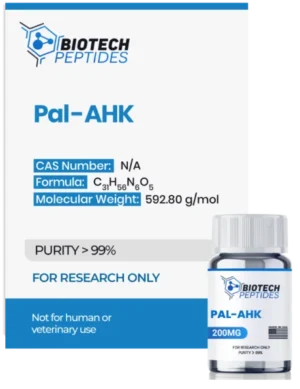
Pal-AHK (200mg)
Pal-AHK, also referred to as Palmitoyl Tripeptide-3, is a tripeptide with a fatty acid attachment. It consists of amino acid sequences (alanine-histidine-lysine) and appears to be attached to a Palmitoyl fatty acid molecule. The fatty-acid component of AHK makes it lipophilic (soluble in fat), which may increase the potential of the peptide for penetration and absorption by epidermal cells in experimental models while maintaining the same mechanisms of action as regular AHK. AHK appears to be a multifunctional copper-binding peptide that has been studied for its potential role in supporting cellular functions related to the kin’s extracellular matrix.
Research indicates that AHK-Cu may increase the proliferation and viability of dermal fibroblasts—the primary cells responsible for producing collagen and other essential proteins in the extracellular matrix (ECM).[1] Moreover, the peptide appears to possess significant antioxidative potential compared to other tripeptides when investigated via chromatographic evaluations. This appears to be related to its potent metal-chelating properties.
$180.00