support@biotechpeptides.ca
-
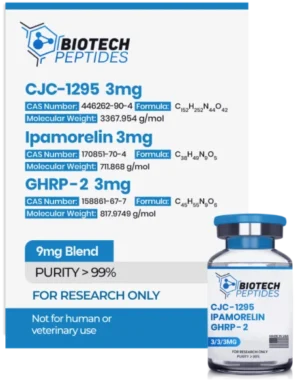
CJC-1295 (Mod GRF 1-29) & Ipamorelin & GHRP-2 Blend (9mg)
CJC-1295 is classified as a Growth Hormone Secretagogue (GHS), also known as DAC:GRF. It is an advanced version of GHRH (1-29), synthetically developed with the intention of producing better pharmacokinetics, potentially increasing Growth Hormone levels and Insulin-Like Growth Factor 1 (IGF-1). According to research, it exhibits the potential to increase the production level of Growth Hormone anywhere from 200-1000%. Moreover, the research developers commented that CJC-1295 may increase “mean plasma IGF-I concentrations by 1.5- to 3-fold.”[1] This apparent rise in growth hormone level has been reported to persist for about 6-8 days under study conditions. A longer half-life would ensure the increased level of growth hormone production even beyond the initial introduction of the peptide.
$80.00 -
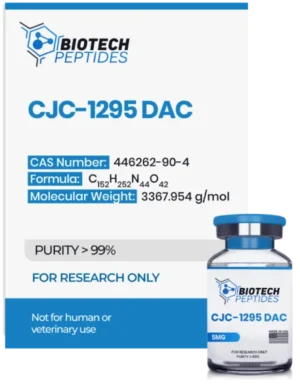
CJC-1295 DAC (5mg)
Specifications
Other Known Titles: CJC-1295 with DAC
Molecular Formula: C152H252N44O42
Molecular Weight: 3367.954 g/mol
Sequence: H-Tyr-D-Ala-Asp-Ala-Ile-Phe-Thr-Gln-Ser-Tyr-Arg-Lys-Val-Leu-Ala-Gln-Leu-Ser-Ala-Arg-Lys-Leu-Leu-Gln-Asp-Ile-Leu-Ser-Arg-Lys(Mal)-NH2
$52.00 -
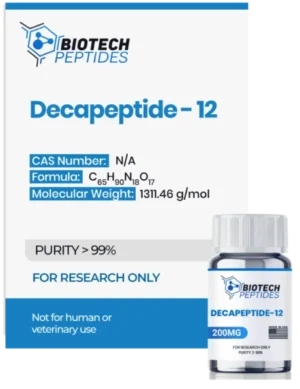
Decapeptide-12 (200mg)
Decapeptide-12 is an oligopeptide with proposed anti-tyrosinase activity, composed of twelve amino acids and exhibiting the sequence Try-Arg-Ser-Aar-Lysd-Tyr-Ser-Ser-Trp-Tyr. It is thought to function primarily to restrain Tyrosinase—the enzyme researchers believe is responsible for the excessive production of melanin, which may result in patchy pigmentation upon the epidermal layer’s surface.
$226.00 -
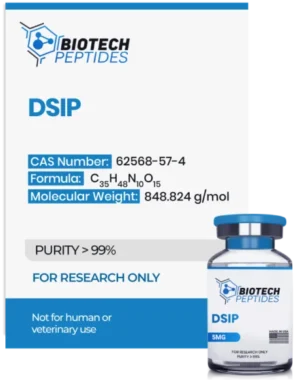
DSIP (5mg)
Specifications
Other Known Titles:Delta Sleep-Inducing Peptide
Molecular Formula: C35H48N10O15
Molecular Weight: 848.82 g/mol
Sequence: Trp-Ala-Gly-Gly-Asp-Ala-Ser-Gly-Glu
$44.00 -
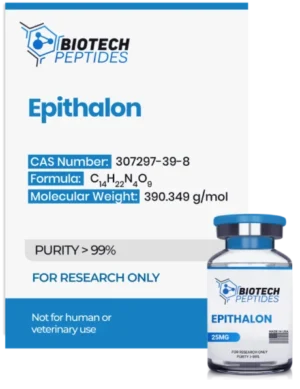
Epithalon (25mg)
Specifications
Molecular Formula: C14H22N4O9
Molecular Weight: 390.34 g/mol
Sequence: Ala-Glu-Asp-Gly
Other Known Titles: Epitalon, Epithalone, Epithalamin
$94.00 -
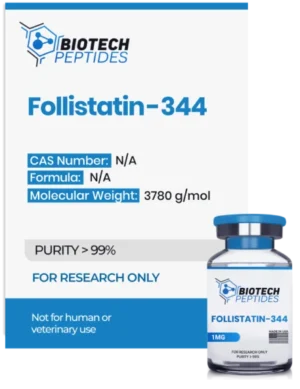
Follistatin-344 (1mg)
Follistatin-344 is a synthetic, full-sized version of a naturally occurring protein bearing the same name. Follistatin-344 occurs in two isomers, varying based on their gene splicing. Follistatin may exist endogenously in two distinct variants, referred to as FST 317 and FST 344. The variants are distinguished by their composition: FST 317 comprises 288 amino acids, whereas FST 344 comprises 315 amino acids. The numerical part of their names reflects the number of amino acids in the precursor molecules from which they are synthesized, with the precursor to FST 317 having 317 amino acids and that to FST 344 having 344 amino acids. It appears that FST 344 is the more commonly occurring form across various tissues. On the other hand, the FST 317 variant likely represents a minor fraction, potentially comprising under 5% of the total mRNA transcript related to Follistatin. Thus, Follistatin-344 appears to be the main constituent. Researchers suggest that its primary role may be to counteract the action of the Tumor Growth Factor-beta (TGF-beta) family. The TGF-beta family comprises Myostatin, Activin, and Follicle Stimulating Growth Hormone (FSH). Follistatin-344 appears to stimulate the Insulin/IGF-1 pathway, and the reported immense potential of the peptide has been published in Follistatin-344 research.
$162.00 -
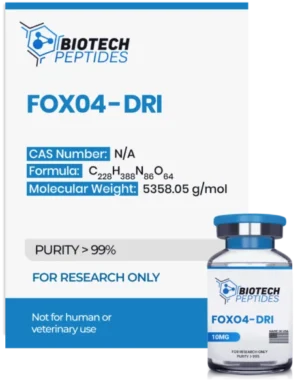
FOXO4-DRI (Proxofim) (10mg)
FOXO4-DRI is a synthetic version of FOXO4, containing D amino acids instead of L amino acids. This modification is intended to allow the peptide to retain the functionality of the original protein but with a longer shelf life and lower clearance. Its most prominent function has been suggested to regulate apoptosis in senescent cells.[1] It has been suggested in scientific studies that senescent cells might exhibit resistance to apoptosis, aka programmed cell death. This resistance has been associated with increased binding of FOXO4 with another protein, p53, which should trigger apoptosis but become inactivated.
$270.00 -
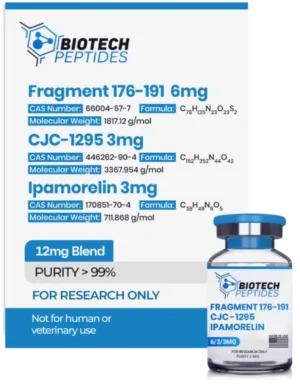
Fragment 176-191 & CJC-1295 & Ipamorelin Blend (12mg)
Fragment 176-191 houses the primary proposed ‘lipolytic fragment’ of the growth hormone (hGH) and it potentially targets the beta-3 adrenergic receptors (ADRB3), which may facilitate its suggested weight-loss potential. This peptide is proposed to amplify fat burning in adipose tissue cells and stimulate ‘thermogenesis’ in skeletal muscle cells via these receptors.[1]
CJC-1295 (Mod GRF 1-29), is an apparently enhanced version of GHRH (1-29) crafted to potentially optimize its pharmacokinetics. It is posited to elevate growth hormone and Insulin-Like Growth Factor 1 (IGF-1) levels. Research suggests it may increase growth hormone production between 200-1000%. Furthermore, CJC-1295 is believed to increase plasma IGF-I concentrations by 1.5- to 3-fold.[2]
Ipamorelin, a five-amino-acid chain, is identified as a Growth Hormone Secretagogue (GHS). It is posited to function similarly to Growth Hormone Releasing Peptides (GHRPs) and to apparently emulate the natural hunger hormone, ghrelin, particularly its potential to stimulate the release of hGH from pituitary cells.[3] A notable feature of Ipamorelin research is its apparent selectivity and its reported negligible influence on the secretion of other pituitary hormones like cortisol, prolactin, and aldosterone.
$87.00 -
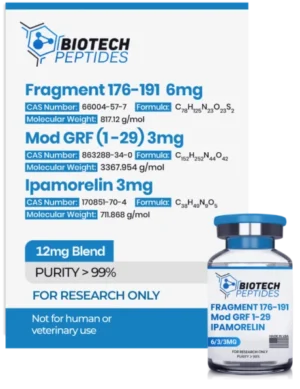
Fragment 176-191 & Mod GRF 1-29 & Ipamorelin Blend (12mg)
Studies have suggested that a maximal output of endogenous growth hormone (GH) from the anterior pituitary gland might be attained through a combination of growth hormone-releasing hormone (GHRH) analog and agonist of growth hormone secretagogue receptor (GHSR).[1] The combination of Ipamorelin with Modified GRF is one of the various combinations researchers have studied in an effort to achieve maximal growth hormone production. Interestingly, more specific results appear to be achieved beyond the increase in GH synthesis by refining the choice of GHRH and GHSR evaluated in a particular study. Modified GRF, which researchers have suggested may be a potent GHRH analog, may have impacts beyond growth hormone release. It has been speculated to impact intestinal inflammation, tissue repair, and cardiac function in addition to researchers’ suppositions on its impact on growth hormone release. Ipamorelin, classified as a growth hormone secretagogue, appears to interact with the GHSRs, also known as ghrelin receptors, and may have the potential to impact bone growth. Activating the ghrelin receptors may affect appetite, to increase food consumption and total weight gain. Depending on the desired outcome of the particular study, namely the addition or reduction of weight, this specific receptor activity may be mitigated by adding lipolytic molecules, which may help minimize the possibility of fat increase. Fragment 176-191 is often combined with Ipamorelin and other research peptides. The peptide known as Fragment 176-191, also referred to as hGH Fragment 176-191, Frag 176-191, tyr-hGH 177-191, or AOD-9604, is hypothesized to specifically target the fat-reduction pathways of growth hormone. This peptide consists of a sequence of 16 amino acids derived from the terminal portion of the growth hormone molecule, identified by researchers as the “lipolytic fragment” due to its potential fat-burning capabilities. The term ‘lipolytic’ describes the fragment’s capacity to promote fat breakdown. To enhance the peptide’s stability, the initial amino acid in the hGH Fragment 176-191 sequence is substituted with tyrosine, leading to its alternate designation as Fragment tyr-hGH 177-191.
$87.00 -
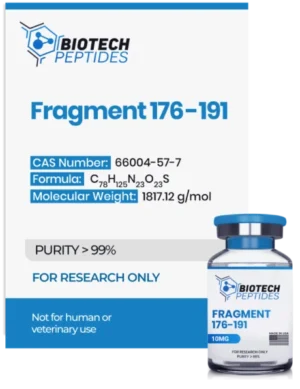
Fragment 176-191 (10mg)
Specifications
Other Known Titles: Frag 176-191
Molecular Formula: C78H125N23O23S2
Molecular Weight: 1817.1 g/mol
Sequence: Tyr-Leu-Arg-Ile-Val-Gin-Cys-Arg-Ser-Val-Glu-Gly-Ser-Cys-Gly-Phe
$67.00 -
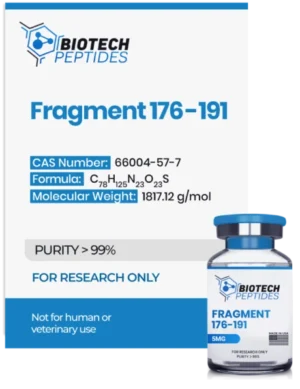
Fragment 176-191 (5mg)
Specifications
Molecular Formula: C78H125N23O23S2
Molecular Weight: 1817.1 g/mol
Sequence: Tyr-Leu-Arg-Ile-Val-Gin-Cys-Arg-Ser-Val-Glu-Gly-Ser-Cys-Gly-Phe
Other Known Titles: Frag 176-191
$44.00 -
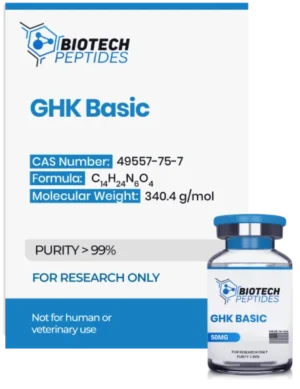
GHK Basic (50mg)
GHK is a copper peptide that occurs naturally in a copper complex of the tripeptide glycyl-L-histidyl-L-lysine. It has two variants — GHK with or without Cu. GHK appears to have a strong affinity for copper (II), and it is synthesized naturally from plasma, although it has been isolated in other areas. In cases of injury, GHK may be released from tissue cells. The copper peptide appears to affect genes that control injury and stress responses. Its functions appear to include the following: tissue remodeling, anti-inflammatory response, pain perception inhibition, nootropic action anti-cancer action, blood vessel growth, and nerve outgrowth. A decrease in the regenerative capacity of an organism may be traced to a decline in GHK-level. Its potential functions extend to infection control, follicle growth, collagen and elastin production increases, tissue repair, and glycosaminoglycan synthesis. Endogenous GHK production is considered to decline over time.
$51.00 -
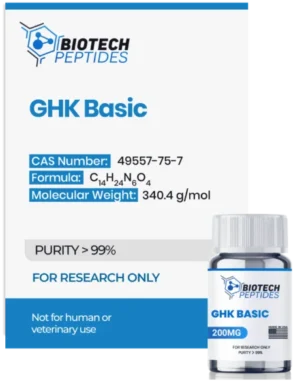
GHK Basic (Tripeptide-1) (200mg)
GHK is an endogenous copper peptide that occurs in the tripeptide glycyl-L-histidyl-L-lysine. It has two variants — GHK with or without Cu (Copper). GHK appears to have a strong affinity for copper (II), and it is synthesized from plasma, although it has been isolated in other areas. Endogenous GHK production is considered to decline over time. [1]
In cases of injury, GHK may be released from tissue cells. That may be because GHK is present in various proteins that get broken down via hydrolysis during injury. For example, studies suggest that GHK is present in the “alpha 2(I) chain of type I collagen”, which “suggests that the tripeptide might be liberated by proteases at the site of a wound and exert in situ healing.” [2] GHK peptide may also be released from the breakdown of another extracellular matrix-binding protein involved in regulating cell shape and proliferation, called SPARC (Secreted Protein, Acidic, and Rich in Cysteine). GHK is found in tissues undergoing remodeling, such as during the process of angiogenesis.[3]
When GHK is released from the breakdown of proteins like collagen and SPARC, this signaling appears to trigger the fibroblasts to begin synthesizing new collagen and other structural proteins in the skin structure and connective tissues like elastin and glycosaminoglycan. Further, this copper-binding peptide appears to affect genes that control recuperative responses to injury and stress. Its functions appear to include the following: tissue remodeling, anti-inflammatory response, pain perception inhibition, nootropic, anti-cancer action, blood vessel growth, and nerve outgrowth.
$165.00 -
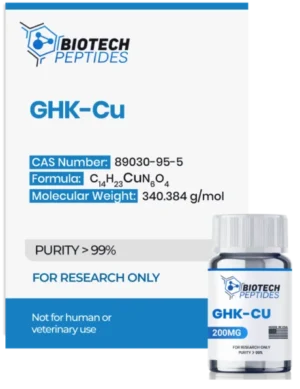
GHK-Cu (200mg)
GHK-Cu (Copper Tripeptide) is a tripeptide that scientists assert is naturally present in blood plasma. It has a sequence of Gly-His-Lys (glycine, histidine, and lysine,) which readily binds with copper to form the copper tripeptide. Scientific studies carried out in different research laboratories worldwide have explored its various biological roles. GHK-Cu exhibits some potential to influence various biological pathways, including an apparent induction of tissue repair, attraction of immune cells, antioxidant and anti-inflammatory characteristics, activation of collagen and glycosaminoglycan synthesis in skin fibroblasts, regulation of extracellular matrix components like decorin, and possible promotion of blood vessel growth. Recent studies indicate its potential role in stem cell biology and anti-tumor research as well.
$186.00 -
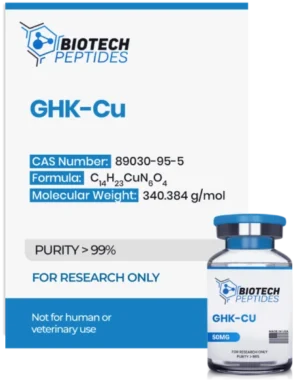
GHK-CU (Copper) (50mg)
Specifications
Molecular Formula: C14H23CuN6O4
Molecular Weight: 340.38 g/mol
Sequence: Gly-His-LysCu.xHAc
$64.00