support@biotechpeptides.ca
-
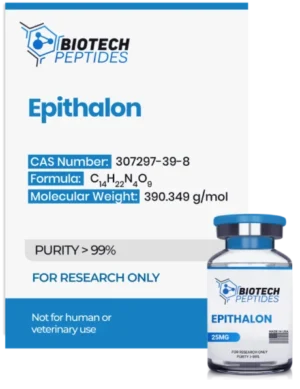
Epithalon (25mg)
Specifications
Molecular Formula: C14H22N4O9
Molecular Weight: 390.34 g/mol
Sequence: Ala-Glu-Asp-Gly
Other Known Titles: Epitalon, Epithalone, Epithalamin
$94.00 -
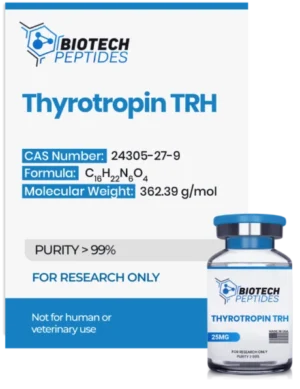
TRH Thyrotropin (Protirelin) (25mg)
Thyrotropin Releasing Hormone (TRH), often called Protirelin, is a small peptide hormone made of 3 amino acids and synthesized in the hypothalamus. The hormone is thought to function via binding to the thyrotropin-releasing hormone receptors TRH-1 and TRH-2. It was developed by researchers with the intention to stimulate the release of both thyroid-stimulating hormone (TSH) and prolactin from the anterior pituitary. TSH, in turn, acts directly on the thyroid gland to promote the synthesis and release of thyroid hormones, primarily triiodothyronine (T3) and thyroxine (T4). TRH has been employed in the study of anterior pituitary gland function in models of thyroid disorders. TRH may exhibit potential roles in TREK-1 channel, in the regulation of cellular aging, arousal, feeding behaviors, autonomic regulation, and mitigating free radical damage.
$93.00 -
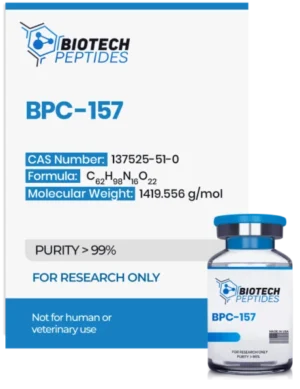
BPC-157 (5mg & 10mg)
Specifications
Molecular Formula: C62H98N16O22
Molecular Weight: 1419.556 g/mol
Sequence: L-Valine,glycyl-L-alpha-glutamyl-L-prolyl-L-prolyl-Lprolylglycyl-L-lysyl-L-prolyl-L-alanyl-L-alpha-aspartyl-L-alpha-aspartyl-L-alanylglycyl-L-leucyl-;glycyl-L-alpha-glutamyl-L-prolyl-L-prolyl-L-prolylglycyllysyl-L-prolyl-L-alanyl-L- alpha-aspartylL-alpha-aspartyl-L-alanylglycyl-L-leucyl-L-valine
Price range: $52.00 through $92.00BPC-157 (5mg & 10mg)
Price range: $52.00 through $92.00 Select options This product has multiple variants. The options may be chosen on the product page -
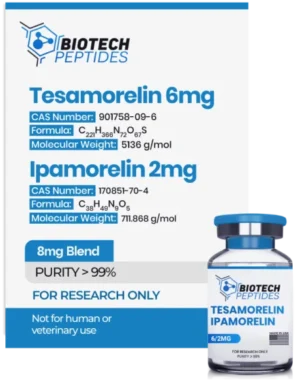
Tesamorelin & Ipamorelin Blend (8mg)
The Tesamorelin & Ipamorelin peptide blend is a mixture of peptide compounds that have been studied for their possible interaction with certain receptors in the cells of the pituitary gland. These receptors include the growth-hormone secretagogue (GHS) receptors and growth hormone-releasing hormone (GHRH) receptors, which are associated with the release of growth hormone (hGH).
Tesamorelin, which is a synthetic peptide, is believed by researchers to act as an analog of growth hormone-releasing hormone through binding to GHRH receptors.[1] Tesamorelin consists of an amino acid chain with 44 amino acids, including a specific sequence similar to GHRH. Additionally, Tesamorelin has been modified in an effort to support its resistance to enzymatic degradation. As an example, the C-terminus of the synthetically developed Tesamorelin has been modified with a trans-3-hexenoic acid group. This modification, known as an omega-amino acid modification, may help improve the peptide’s resistance to enzymatic degradation.
Tesamorelin also has an acetyl group (CH₃CO-) attached to its N-terminus, which may potentially enhance the stability and bioactivity of the peptide. As a result, the peptide is also known as N-(trans-3-hexenoyl)-[Tyr1]hGRF(1–44)NH2 acetate.[2] By interacting with GHRH receptors in the pituitary and hypothalamus, Tesamorelin may trigger the release of hGH from pituitary cells.
Similarly, Ipamorelin is also a synthetic peptide that interacts with pituitary cells and may stimulate the synthesis and release of hGH. Its proposed mechanism of action involves interaction with GHS receptors, also known as ghrelin receptors, which are found in the pituitary and hypothalamus.[3] By activating these receptors, Ipamorelin may mimic the actions of ghrelin on the pituitary gland, potentially leading to the release of growth hormone from pituitary cells.
$90.00 -
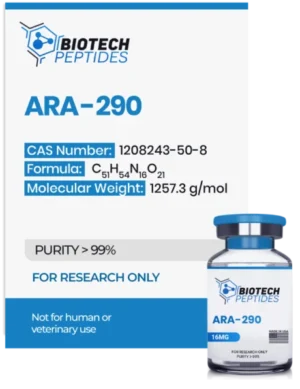
ARA-290 (16mg)
Erythropoietin (EPO) is a kidney-derived glycoprotein made of 11 amino acids that has been studied for its potential to promote blood vessel growth and repair, and possible neuroprotection in the case of diabetic neuropathy. ARA-290 is a peptide derived from the beta-helix domain of EPO.[1] ARA-290 was developed with the intention of stimulating pain-mitigating and neuroprotective activity of EPO, though without promoting blood cell formation. ARA-290 has been proposed by researchers to exhibit anti-apoptotic, anti-inflammatory, and anti-permeability characteristics, akin to the endogenous glycoprotein, EPO. The peptide is being evaluated for its potential in neuropathic wound healing, immunomodulation, and within the context of Systemic Lupus Erythematosus (SLE) research.
$88.00 -
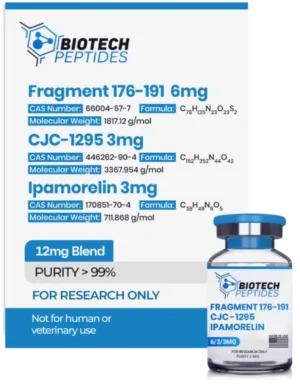
Fragment 176-191 & CJC-1295 & Ipamorelin Blend (12mg)
Fragment 176-191 houses the primary proposed ‘lipolytic fragment’ of the growth hormone (hGH) and it potentially targets the beta-3 adrenergic receptors (ADRB3), which may facilitate its suggested weight-loss potential. This peptide is proposed to amplify fat burning in adipose tissue cells and stimulate ‘thermogenesis’ in skeletal muscle cells via these receptors.[1]
CJC-1295 (Mod GRF 1-29), is an apparently enhanced version of GHRH (1-29) crafted to potentially optimize its pharmacokinetics. It is posited to elevate growth hormone and Insulin-Like Growth Factor 1 (IGF-1) levels. Research suggests it may increase growth hormone production between 200-1000%. Furthermore, CJC-1295 is believed to increase plasma IGF-I concentrations by 1.5- to 3-fold.[2]
Ipamorelin, a five-amino-acid chain, is identified as a Growth Hormone Secretagogue (GHS). It is posited to function similarly to Growth Hormone Releasing Peptides (GHRPs) and to apparently emulate the natural hunger hormone, ghrelin, particularly its potential to stimulate the release of hGH from pituitary cells.[3] A notable feature of Ipamorelin research is its apparent selectivity and its reported negligible influence on the secretion of other pituitary hormones like cortisol, prolactin, and aldosterone.
$87.00 -
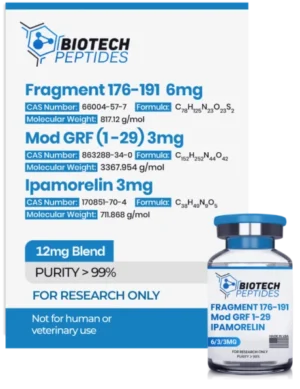
Fragment 176-191 & Mod GRF 1-29 & Ipamorelin Blend (12mg)
Studies have suggested that a maximal output of endogenous growth hormone (GH) from the anterior pituitary gland might be attained through a combination of growth hormone-releasing hormone (GHRH) analog and agonist of growth hormone secretagogue receptor (GHSR).[1] The combination of Ipamorelin with Modified GRF is one of the various combinations researchers have studied in an effort to achieve maximal growth hormone production. Interestingly, more specific results appear to be achieved beyond the increase in GH synthesis by refining the choice of GHRH and GHSR evaluated in a particular study. Modified GRF, which researchers have suggested may be a potent GHRH analog, may have impacts beyond growth hormone release. It has been speculated to impact intestinal inflammation, tissue repair, and cardiac function in addition to researchers’ suppositions on its impact on growth hormone release. Ipamorelin, classified as a growth hormone secretagogue, appears to interact with the GHSRs, also known as ghrelin receptors, and may have the potential to impact bone growth. Activating the ghrelin receptors may affect appetite, to increase food consumption and total weight gain. Depending on the desired outcome of the particular study, namely the addition or reduction of weight, this specific receptor activity may be mitigated by adding lipolytic molecules, which may help minimize the possibility of fat increase. Fragment 176-191 is often combined with Ipamorelin and other research peptides. The peptide known as Fragment 176-191, also referred to as hGH Fragment 176-191, Frag 176-191, tyr-hGH 177-191, or AOD-9604, is hypothesized to specifically target the fat-reduction pathways of growth hormone. This peptide consists of a sequence of 16 amino acids derived from the terminal portion of the growth hormone molecule, identified by researchers as the “lipolytic fragment” due to its potential fat-burning capabilities. The term ‘lipolytic’ describes the fragment’s capacity to promote fat breakdown. To enhance the peptide’s stability, the initial amino acid in the hGH Fragment 176-191 sequence is substituted with tyrosine, leading to its alternate designation as Fragment tyr-hGH 177-191.
$87.00 -
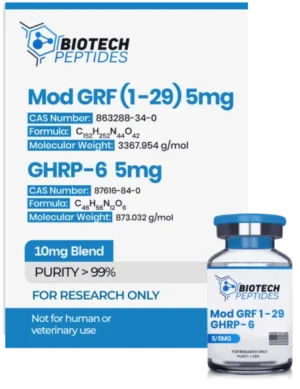
Mod GRF 1-29 & GHRP-6 (10mg)
Modified Growth Hormone Releasing Factor (Mod GRF 1-29) and Growth Hormone Releasing Peptide-6 (GHRP-6) are two peptides that researchers believe may support the secretion of growth hormone (GH) from cells in the anterior pituitary gland. The peptides may offer this support through distinct biological pathways. Mod GRF (1-29) is a synthetic peptide derived from Growth Hormone Releasing Hormone (GHRH), an endogenous hormone consisting of 44 amino acids that stimulates GH release. Some studies have indicated that the initial 29 amino acids of GHRH retain their full biological activity.[1] Modifications to this fragment, resulting in Mod GRF (1-29), are believed to increase its potency and prolong its duration of action, possibly due to better-supported stability against enzymatic degradation.
$86.00 -
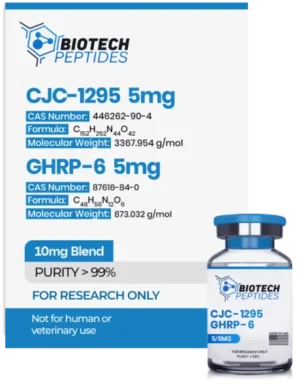
CJC-1295 & GHRP-6 Blend (10mg)
The CJC-1295 & GHRP-6 blend have been posited by researchers to display a synergistic action on cells that participate in the release of growth hormone. More specifically, the mix includes CJC-1295, which appears to be similar in action to growth hormone-releasing hormone (GHRH), and GHRP-6 (Growth Hormone Releasing Peptide 6), which appears to bind to the receptors of the hunger hormone ghrelin.This combination of peptides may possibly increase both the strength and the number of growth hormone signals from somatotroph cells. CJC-1295 appears to target the GHRH receptor pathway, while GHRP-6, is considered by researchers to act on the ghrelin receptor pathway. This may explain why the combination of CJC-1295 and GHRP-6 exhibits potential to interact with somatotroph cells in the pituitary gland and the hypothalamus. Both of these regions in the central nervous system are considered to be comprised of cells that are believed to be important in making and controlling growth hormone synthesis.
$86.00 -

PTD-DBM (5mg)
PTD-DBM stands for Protein Transduction Domain-fused Disheveled Binding Motif. It is a synthetic peptide which has been studied within a wide range of research areas, including tissue damage and hair follicle development. Researchers have focused on the peptide specifically within the context of follicle development, suggested it may exert stimulating action through interaction with the endogenous proteins linked to follicle damage called CXXC5.[1] It was discovered by Professor Kang-Yell Choi and his team of researchers at the Yonsei University in South Korea. The researchers studied the mechanism of hair follicle loss, and suggested that the cellular pathway Wnt/β-catenin may be crucial for follicle development.
The Wnt/β-catenin pathway is often studied in the context of tissue development and regeneration, Wnt proteins are a family of secreted signaling molecules that bind to cell surface receptors to trigger a cascade of intracellular events. β-catenin is a protein that normally resides in the cytoplasm of cells. Upon activation of the Wnt pathway, β-catenin is thought to accumulate in the cell and translocate to the nucleus, where it may activate the transcription of specific target genes involved in cell growth and differentiation. The activation of β-catenin may have a role in supporting and even increasing hair follicle development and possibly initiating the anagen phase, which represents the growth stage of hair follicles, as observed in murine models.
It has been hypothesized that PTD-DBM may interfere with the binding of CXXC5 and Dishevelled (Dvl) proteins by acting as a competitor. Specifically the peptide might inhibit the interaction between CXXC5 and Dishevelled (Dvl) proteins by binding to the PDZ domain of Dvl, thus interfering with CXXC5’s inhibitory actions on Wnt/β‐catenin signaling. Such a disruption might support the Wnt/β-catenin signaling pathway, thereby possibly promoting the onset of the anagen phase. Data from such murine studies suggests elevated expression levels of β-catenin, alkaline phosphatase (ALP), and proliferating cell nuclear antigen (PCNA), which are markers linked to cellular proliferation and hair follicle functionality.
$86.00 -
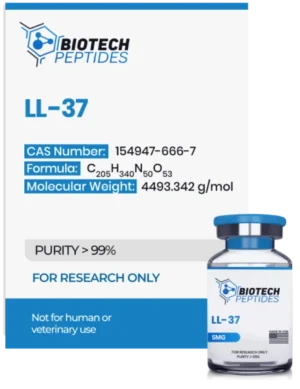
LL-37 (5mg)
LL-37 is a Cathelicidin, a protein family of unique and diverse functions. These peptides, produced by macrophages and polymorphonuclear leukocytes (both types of white blood cells), have been suggested to exhibit bactericidal action. The entire group is classified as antimicrobial peptides (AMPs). The peptide, in particular, has been researched in relation to autoimmune disease, cancer, and wound recovery.[1] For example, researchers note that “Corneal and conjunctival epithelia express LL-37 as part of mucosal innate immunity to protect against bacterial and viral ocular infections.”
$86.00 -
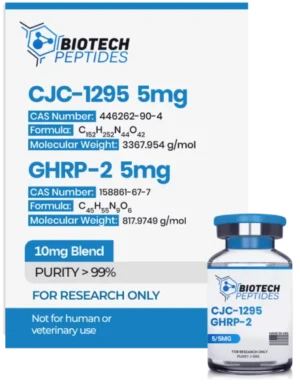
CJC-1295 & GHRP-2 Blend (10mg)
CJC-1295 & GHRP-2 blend combines two peptides with different structures; both have been researched for their proposed affinity for receptors in the pituitary gland and other parts of the central nervous system. Despite activating different receptors, CJC-1295 & GHRP-2 may exhibit similar action.
CJC-1295 is a molecule that appears to bind to the growth hormone-releasing hormone (GHRH) receptors, which may cause the release of growth hormone by pituitary cells. CJC-1295 is derived from GHRH 1-29, the shortest functional sequence of GHRH consisting of the first 29 amino acids. CJC-1295 is a tetrasubstituted version of the peptide that is also modified by adding a drug affinity complex (DAC) component called N-epsilon-3-maleimidopropionamide, which appears to bind to plasma proteins and may improve CJC-1295 pharmacokinetics.
GHRP-2, or Growth Hormone Releasing Peptide 2, is a synthetic hexapeptide composed of six amino acids. This peptide appears to bind to ghrelin or growth hormone secretagogue 1a receptors (GHS-R1a) found in the hypothalamus and the pituitary gland. As a result, GHRP-2 also appears to stimulate the production of growth hormone (GH) in pituitary cells that express this receptor.
$84.00 -
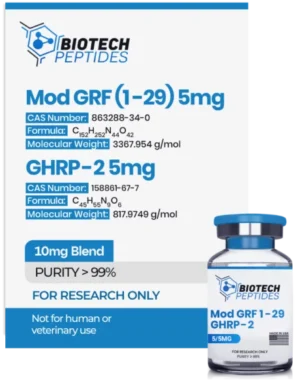
Mod GRF 1-29 & GHRP-2 Blend (10mg)
Modified GRF 1-29 (also abbreviated as Mod GRF 1-29), is a synthetic peptide analog of Growth Hormone Releasing Hormone (GHRH). It is a modified version of the first twenty-nine amino acids of the naturally occurring GHRH. This modification has been suggested to provide better stability and potentially reduce metabolic clearance. More specifically, the modifications may involve the substitution of four specific amino acids within the initial 29 amino acids of Growth Hormone-Releasing Hormone (GHRH). These changes occur at the 2nd, 8th, 15th, and 27th positions and may potentially enhance the peptide’s durability against enzymatic degradation, especially by enzymes such as dipeptidyl peptidase-4 (DPP-4). It is hypothesized that replacing L-alanine with D-alanine at the second position may increase resistance to molecular breakdown. Furthermore, replacing asparagine with glutamine at the eighth position might reduce the likelihood of asparagine reconfiguration and amide hydrolysis. Additionally, substituting glycine with alanine at the 15th position may improve bioactivity. Lastly, the switch from methionine to leucine at the 27th position is thought to help prevent methionine oxidation. It may lead to natural growth hormone production and increased levels of IGF-1 (Insulin-Like Growth Factor-1).
$84.00 -
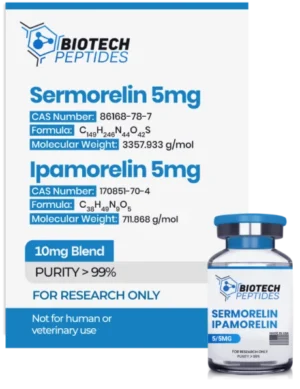
Sermorelin & Ipamorelin Blend (10mg)
Molecular Formula: C149H246N44O42S
Molecular Weight: 3357.9 g/mol
Sequence: Tyr-Ala-Asp-Ala-lle-Phe-DL-Thr-Asn-Ser-Tyr-Arg-Lys-Val-Leu-Gly-Gln-Leu-Ser-Ala-Arg-Lys-Leu-Leu-Gln-Asp-Ile-Met-Ser-Arg-NH2
$81.00 -
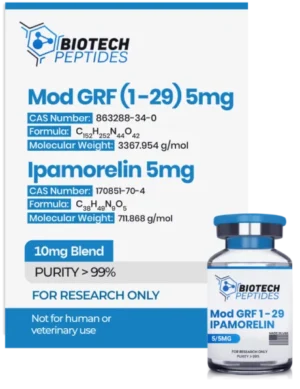
Mod GRF 1-29 & Ipamorelin Blend (10mg)
Modified GRF 1-29 and Ipamorelin are separate peptides, which research indicates may work synergistically to induce potential growth hormone release and growth hormone pulses. This increase may result in several downstream physiological activities associated with increased growth hormone release. Modified GRF 1-29 peptide is an analog of growth hormone-releasing hormone (GHRH).[1] It is also known as tetra-substituted GRF (1-29), and is composed of a sequence thought to be the smallest necessary to interact with GHRH receptors, specifically the first 29 amino acids of GHRH. On the other hand, Ipamorelin is suggested to act via binding to growth hormone secretagogue (GHS) receptors.[2] These receptors are also known as the ghrelin receptors, and Ipamorelin appears to be a highly selective pentapeptide that binds and activates them.
$81.00