support@biotechpeptides.ca
-

Retatrutide (6mg)
AMP-3P 6mg is a ≥ 99 % pure triple-agonist peptide supplied as a lyophilized
powder.$55.00 -
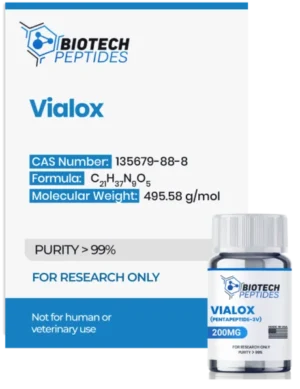
Vialox (Pentapeptide-3V) (200mg)
Vialox, also known as Pentapeptide-3V, is a peptide with a five amino acid sequence (Gly-Pro-Arg-Pro-Ala). It was originally isolated from endogenously produced snake venom. The peptide appears to replicate temporary muscular paralysis. This result has been observed by researchers in paralytic compounds such as botulinum toxin, which are believed to reduce wrinkle depth. Vialox appears to inhibit nicotinic acetylcholine receptors. This potential may enable curare-like actions at the neuromuscular junction, which might block nervous system electrical impulses from reaching muscles. A block like this may ultimately halt muscle contraction.
This mechanism appears to be analogous to the function of tubocurarine. This function is observed through Vialox’s hypothetical interaction with acetylcholine receptors on the postsynaptic membrane of muscle cells. Tubocurarine, a naturally occurring alkaloid compound, is primarily found in the bark of certain plants. This includes Chondrodendron tomentosum, commonly referred to as “curare.” Experts recognize this compound as a potent neurotoxin. Its mode of action is considered to function as a non-depolarizing neuromuscular blocker. It is hypothesized that this function obstructs the activity of acetylcholine—a neurotransmitter deemed by researchers to be critical for muscle contraction—at the neuromuscular junction, which might inhibit muscle contraction.
$210.00 -
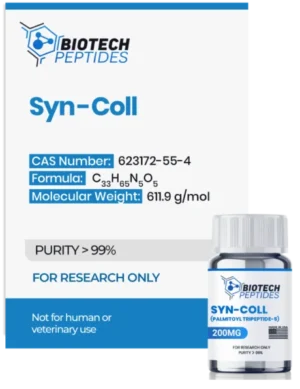
Syn-Coll (Palmitoyl Tripeptide-5) (200mg)
Syn-Coll, otherwise known as Palmitoyl Tripeptide-5 or Tripeptide-5, is a synthetic peptide that was developed to enhance the production of type I collagen. It appears to repair damages caused by photo-aging, and Syn-Coll has also been suggested to support the regeneration of skin protein production, such as elastin or collagen. Syn-Coll (Palmitoyl Tripeptide-5) is the synthetic equivalent of Thrombospondin 1 (TSP-1). TSP-1 is an extracellular matrix protein and is found in the skin near collagen and elastin. Syn-Coll appears to mimic the functions of TSP-1, possibly aiding in the prevention of collagen degeneration via stimulating the release of TGF- induced by TSP-1.[1] TGF-β is an essential growth factor potentially significant in preserving skin integrity and facilitating the development of skin structures, mainly through the promotion of collagen synthesis. Additionally, Syn-Coll, a synthetic peptide, has been the subject of extensive research in animal models and laboratory experiments. The findings tentatively indicate that Syn-Coll might enhance collagen production and potentially inhibit its degradation. The inhibition of collagen breakdown by Syn-Coll is possibly due to its ability to suppress the activity of matrix metalloproteinases (MMPs), including MMP1 and MMP3, which are enzymes studied for their role in the degradation of collagen in the skin. The peptide is palmitoylated, to potentially extend its bioavailability in experiments involving different skin tissue models.
$217.00 -
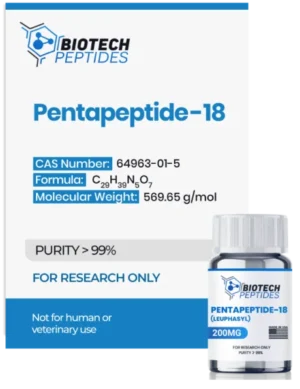
Pentapeptide-18 (Leuphasyl) (200mg)
Pentapeptide-18 (Leuphasyl) is a modified analog of the naturally occurring pentapeptide leu-enkephalin, which is part of a class of peptides called enkephalins which are believed to directly interact with opioid receptors.[1] Structurally, Pentapeptide-18 differs from leu-enkephalin by the addition of D-Alanine in place of glycine at its second position. Pentapeptide-18 is thought to penetrate the epidermal barrier and influence cellular processes that affect muscle cell contraction. Studies suggest that it acts by modulating calcium release in neuronal synapses. By interfering with the signals that trigger muscle contraction, Pentapeptide-18 may help to relax muscles, reducing the formation of fine lines and wrinkles across the skin barrier. Additionally, modified versions of Pentapeptide-18 may interact with melanin production pathways, which is a pigment responsible for adding color to tissues and may play a protective role against UV radiation. By potentially influencing melanin synthesis, modified versions of Pentapeptide-18 may offer research value in skin tissue studies.
$215.00 -
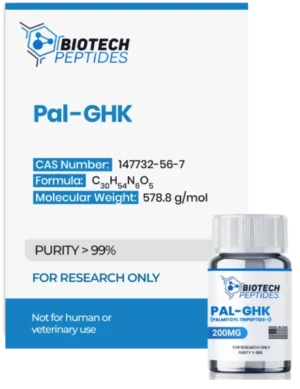
Pal-GHK (Palmitoyl Tripeptide-1) (200mg)
Pal-GHK, also known as Palmitoyl Tripeptide-1 and Palmitoyl Oligopeptide, is a synthetic peptide developed to function in protein production to support the skin’s extracellular matrix (ECM), and skin pigmentation. Pal-GHK is a synthetic hybrid peptide with one fatty acid and one peptide. “Pal” represents Palmitoyl—the covalent attachment of fatty acid to the end of the structure. “GHK” represents glycine-histidine-lysine—the peptide’s amino acid structure. This sequence is thought to be a small fraction of the large protein collagen, which is one of the main proteins in the extracellular matrix of skin and other tissues. The GHK sequence appears to be present in the “alpha 2(I) chain of type I collagen”, and researchers suggest that such a “tripeptide might be liberated by proteases at the site of a wound” as a signal of injury and thus, may be a powerful stimulant for repair.[1] Particularly, it may signal and attract fibroblasts—cells responsible for synthesizing collagen, elastin, and other proteins in the skin’s extracellular matrix, bones, and connective tissues. “Pal” represents Palmitoyl—the covalent attachment of fatty acid to the end of the structure. The addition of palmitoyl to the molecule is thought to result in better penetration through skin cells and, more specifically, stratum corneum.
$119.00 -
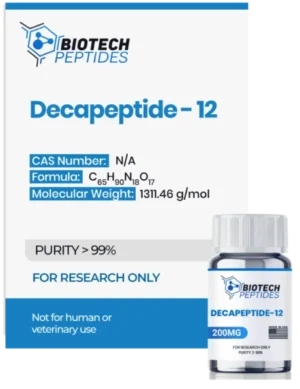
Decapeptide-12 (200mg)
Decapeptide-12 is an oligopeptide with proposed anti-tyrosinase activity, composed of twelve amino acids and exhibiting the sequence Try-Arg-Ser-Aar-Lysd-Tyr-Ser-Ser-Trp-Tyr. It is thought to function primarily to restrain Tyrosinase—the enzyme researchers believe is responsible for the excessive production of melanin, which may result in patchy pigmentation upon the epidermal layer’s surface.
$226.00 -
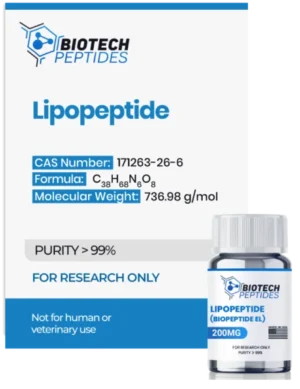
Lipopeptide (Biopeptide EL) (200mg)
Lipopeptide is a common name for Biopeptide EL, also known as palmitoyl hexapeptide-12. As the name suggests, this peptide is made of six amino acids and has a palmitic fatty acid addition. The inclusion of palmitic acid within the Lipopeptide structure is thought to enhance penetration to the deeper layers of various structures made of skin cells. The amino acids in the peptide are valine-glycine-valine-alanine-proline-glycine (VGVAPG), and the sequence is one of the most common found in naturally occurring proteins like elastin and its precursor, tropoelastin.
By mimicking fragments of elastin, the peptide is thought to interact with fibroblast cells and exert a potential impact on the production of vital proteins to the skin’s extracellular matrix (ECM). Fibroblasts are a subset of cells found in connective tissue, such as the one that provides support for skin cells. Fibroblasts can actively produce ECM proteins, and some of the most important proteins are considered to be collagen, elastin, and hyaluronic acid. According to scientific research, Lipopeptide may potentially enhance the creation and growth of collagen and hyaluronic acid within the ECM.
$220.00 -
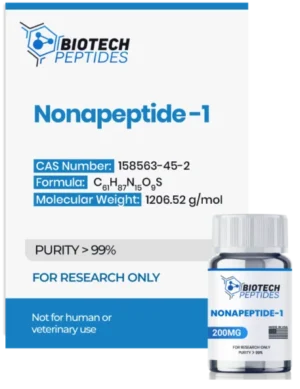
Nonapeptide-1 (200mg)
Nonapeptide-1, also termed Melanostatine-5, is a peptide that may prevent the activation of pigment-producing cells in the skin called melanocytes. It appears to be one of the most potent inhibitors of a receptor found in these pigment-producing cells, called the melanocortin-1 receptor (MC1R). Researchers have explored a peptide library containing 31,360 structurally different compounds, and it appears that the most potent inhibitor identified was Met-Pro-D-Phe-Arg-D-Trp-Phe-Lys-Pro-Val-NH₂, aka Nonapeptide-1.[1] Structural analysis has revealed that specific amino acids, such as D-Trp at position 5 and Phe at position 6, are considered crucial for their antagonistic potential. The presence of D-Phe at position 3 further underscores such potential. Research on animal models suggests that Nonapeptide-1 may inhibit the synthesis of melanin, bringing it to the forefront of research on conditions impacting skin pigmentation, such as melasma. Studies in animal models posit that Nonapeptide-1 may reduce the synthesis of melanin and potentially decrease pigmentation on a considerable scale.
$210.00 -
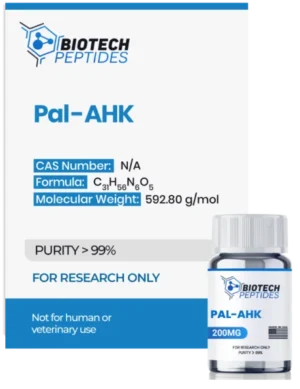
Pal-AHK (200mg)
Pal-AHK, also referred to as Palmitoyl Tripeptide-3, is a tripeptide with a fatty acid attachment. It consists of amino acid sequences (alanine-histidine-lysine) and appears to be attached to a Palmitoyl fatty acid molecule. The fatty-acid component of AHK makes it lipophilic (soluble in fat), which may increase the potential of the peptide for penetration and absorption by epidermal cells in experimental models while maintaining the same mechanisms of action as regular AHK. AHK appears to be a multifunctional copper-binding peptide that has been studied for its potential role in supporting cellular functions related to the kin’s extracellular matrix.
Research indicates that AHK-Cu may increase the proliferation and viability of dermal fibroblasts—the primary cells responsible for producing collagen and other essential proteins in the extracellular matrix (ECM).[1] Moreover, the peptide appears to possess significant antioxidative potential compared to other tripeptides when investigated via chromatographic evaluations. This appears to be related to its potent metal-chelating properties.
$180.00 -
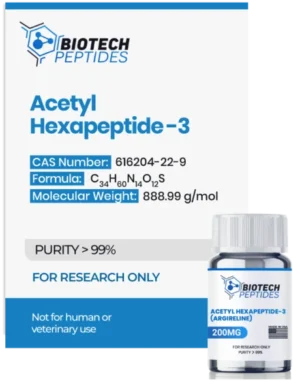
Acetyl Hexapeptide-3 (Argireline) (200mg)
Acetyl Hexapeptide-3 (Argireline) is a peptide chain of amino acids with the following sequence: Ac-Glu-Glu-Met-Gln-Arg-Arg-NH2. It is a fragment of the SNAP-25 (synaptosome-associated protein 25 kDa).[1] SNAP-25 is a key component of the SNARE (Soluble N-ethylmaleimide-sensitive factor Attachment protein Receptor)-Synaptotagmin-1 complex. This is a protein assembly that facilitates the release of neurotransmitters, such as acetylcholine, into the synaptic cleft between nerve cells and muscle cells. SNAP-25 is considered to be critical in this process because it appears to be in the assembly of the SNARE complex. This may also lead to the release of acetylcholine, thus triggering muscle contraction. Acetyl Hexapeptide-3 resembles the SNAP-25 protein, particularly the portion that is believed essential for SNARE complex formation.
By inhibiting its formation, the peptide may also prevent neurotransmitter release and muscle contraction. Researchers have investigated Acetyl Hexapeptide-3 (Argireline) for its potential to support skin cell structure and reduce wrinkling along the stratum corneum. Continuous muscle movements result in wrinkling, and the devitalization of muscle contractions may possibly inhibit the development of new lines and decrease the depth of existing skin tissue creases and wrinkles. Acetyl Hexapeptide-3 (Argireline) may prevent muscles from moving or contracting. Researchers also posit that the peptide may support endogenous collagen production to preserve the skin’s extracellular matrix.
$210.00 -
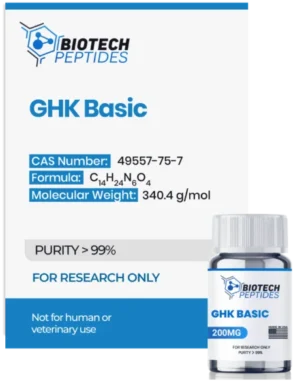
GHK Basic (Tripeptide-1) (200mg)
GHK is an endogenous copper peptide that occurs in the tripeptide glycyl-L-histidyl-L-lysine. It has two variants — GHK with or without Cu (Copper). GHK appears to have a strong affinity for copper (II), and it is synthesized from plasma, although it has been isolated in other areas. Endogenous GHK production is considered to decline over time. [1]
In cases of injury, GHK may be released from tissue cells. That may be because GHK is present in various proteins that get broken down via hydrolysis during injury. For example, studies suggest that GHK is present in the “alpha 2(I) chain of type I collagen”, which “suggests that the tripeptide might be liberated by proteases at the site of a wound and exert in situ healing.” [2] GHK peptide may also be released from the breakdown of another extracellular matrix-binding protein involved in regulating cell shape and proliferation, called SPARC (Secreted Protein, Acidic, and Rich in Cysteine). GHK is found in tissues undergoing remodeling, such as during the process of angiogenesis.[3]
When GHK is released from the breakdown of proteins like collagen and SPARC, this signaling appears to trigger the fibroblasts to begin synthesizing new collagen and other structural proteins in the skin structure and connective tissues like elastin and glycosaminoglycan. Further, this copper-binding peptide appears to affect genes that control recuperative responses to injury and stress. Its functions appear to include the following: tissue remodeling, anti-inflammatory response, pain perception inhibition, nootropic, anti-cancer action, blood vessel growth, and nerve outgrowth.
$165.00 -
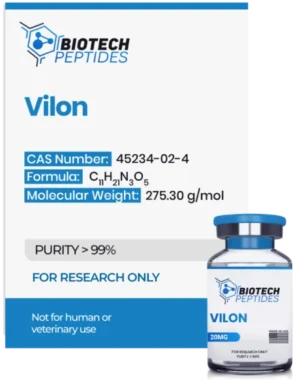
Vilon (20mg)
Vilon (or Lyslglutamic Acid) is a peptide with apparent immunomodulatory and anti-aging bioregulation potential. It is a short peptide with just two amino acids in length. Scientific research suggests it may potentially act to regulate the vascular system and encourage hemostasis. Its functions may be more widespread, with studies indicating its possible influence in reducing the prevalence and growth of spontaneous tumors. Advocate researchers like Dr. Vladimir Anisimov believe that the peptide may become more widespread in contemporary research within the context of geroprotection.
$61.00 -
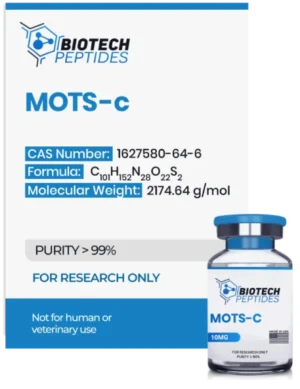
MOTS-c (10mg)
MOTS-c (mitochondrial open-reading-frame of the 12S rRNA-c) is a 16 amino acid peptide classified as a Mitochondrial-Derived Peptide (MDP), aka “mitochondrial hormone” or “mitokine.” Recent research indicates that MOTS-c is a bioactive peptide closely associated with mitochondrial communication and energy regulation. Initially, researchers hypothesized that it might be most active in the mitochondria, however recent studies suggest otherwise, that MOTS-c may operate via the bloodstream, exhibiting a potentially systemic action.
It is important to note that MOTS-c is a newly identified MDP. Its primary roles are under investigation, but studies include MOTS-c peptide’s influence in cell function and longevity, muscle contractile force, metabolic function and weight regulation.
$99.00 -
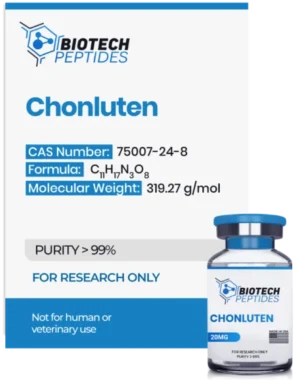
Chonluten (T-34) (20mg)
Chonluten is also known as Tripeptide T-34 or EDG, due to its sequence (Glu-Asp-Gly). It is a cytogenetic complex consisting of short peptides that are suggested to normalize the mucous membrane cells of the lungs and the bronchial tube. It is a gene regulator associated with inflammation and antioxidant activity, and is considered to be involved in proliferation responses.[1] It appears to function in animal test models as an anti-inflammatory in the lungs, normalizing the mucosal functions of the lungs in conditions like asthma and chronic obstructive pulmonary disease (COPD).
$62.00 -
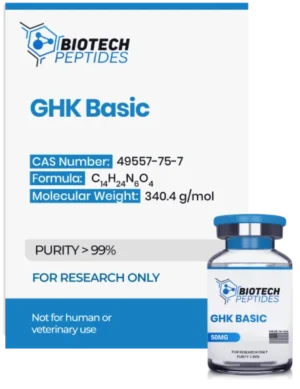
GHK Basic (50mg)
GHK is a copper peptide that occurs naturally in a copper complex of the tripeptide glycyl-L-histidyl-L-lysine. It has two variants — GHK with or without Cu. GHK appears to have a strong affinity for copper (II), and it is synthesized naturally from plasma, although it has been isolated in other areas. In cases of injury, GHK may be released from tissue cells. The copper peptide appears to affect genes that control injury and stress responses. Its functions appear to include the following: tissue remodeling, anti-inflammatory response, pain perception inhibition, nootropic action anti-cancer action, blood vessel growth, and nerve outgrowth. A decrease in the regenerative capacity of an organism may be traced to a decline in GHK-level. Its potential functions extend to infection control, follicle growth, collagen and elastin production increases, tissue repair, and glycosaminoglycan synthesis. Endogenous GHK production is considered to decline over time.
$51.00